
A physical vapor deposition system is an engineered vacuum machine that converts solid coating materials into a vapor and deposits them as thin, dense films on parts. It enables wear resistance, low friction, and corrosion protection on production tools and components. For Woodbridge manufacturers, the right PVD platform drives longer tool life and steadier throughput.
By Ron, Sputtek • Last updated: July 4, 2026
Quick Summary and Table of Contents
This guide explains what a physical vapor deposition system is, how it works, where it fits, and how to choose one. You’ll see system types, selection criteria, best practices, tools, and real examples from Sputtek’s SPUN series. Use the table of contents below to jump to what you need.
- What is a physical vapor deposition system?
- Why PVD systems matter for manufacturing
- How a PVD system works
- Types of PVD systems and methods
- Selection and best practices
- Tools, fixtures, and resources
- Case studies and real examples
- Frequently Asked Questions
- Conclusion and next steps
What is a physical vapor deposition system?
A physical vapor deposition system is a vacuum-based machine that vaporizes a solid source (targets, cathodes, or ingots) and deposits that vapor as a thin coating on parts. The result is a hard, adherent film—often 1–5 micrometers thick—that improves wear, friction, and corrosion performance on tools and components.
A modern PVD platform combines vacuum chambers, pumping, power supplies, process gases, control software, and fixtures. The chamber routinely reaches base pressures near 1×10⁻⁶ Torr, keeping the path between source and substrate clean and predictable. Films like TiN, TiCN, CrN, AlTiN, and DLC are typical choices for industrial tools.
- What it delivers: Higher wear resistance, lower coefficient of friction, and oxidation resistance for dies, molds, and cutting tools.
- Where it’s used: Automotive stamping, plastic injection molding, aluminum die casting and extrusion, machining, medical devices, energy, and packaging.
- Typical film range: About 1–5 μm for tools; decorative or functional layers can be thinner or thicker depending on duty cycle.
At Sputtek, we pair PVD services and in-house system design. Our SPUN 2,000 handles up to about 1,200 kg per coating cycle, while SPUN 4,000 scales to roughly 3,000 kg per cycle—useful when you need stable throughput on multi-shift production.
Local considerations for Woodbridge
- Coordinate deliveries around SmartCentres Woodbridge traffic peaks to streamline incoming tool batches and reduce idle time at the dock.
- Plan preventive maintenance windows during summer shutdowns or around long weekends near Weston Rd / Highway 7 to align with staffing and logistics.
- Leverage local technical support for quick fixture tweaks; proximity shortens debug cycles on first-article runs.
Why PVD systems matter for manufacturing
PVD systems extend tool life, cut unplanned downtime, and stabilize quality. By depositing hard, low-friction films on working surfaces, they reduce adhesive wear, galling, and heat—improving part yield and run length without redesigning tooling or changing the base alloy.
Wear and friction limit throughput. In stamping, for instance, adhesive wear can spike scrap rates on high-strength steels. In molding, resin sticking slows ejection and mars surfaces. A PVD layer with the right hardness and chemistry addresses these root causes at the surface interface.
- Run longer between regrinds: Many production teams move from single-shift regrinds to multi-shift intervals after dialed-in PVD recipes.
- Protect edges and radii: Dense films preserve micro-geometry on punches, inserts, and end mills.
- Stabilize release: On injection molds and cavity cores, low-friction coatings improve demolding consistency across thousands of cycles.
- Broaden process windows: Coated tooling tolerates higher speeds or tougher alloys with fewer adjustments.
Because PVD is line-of-sight and tightly controlled, you can target only the surfaces that work, maintaining tolerances elsewhere. Sputtek’s ISO 9001:2015 quality system and Nuclear N299.3 vendor approval align with regulated sectors where documentation, traceability, and repeatability are non-negotiable.
How a PVD system works
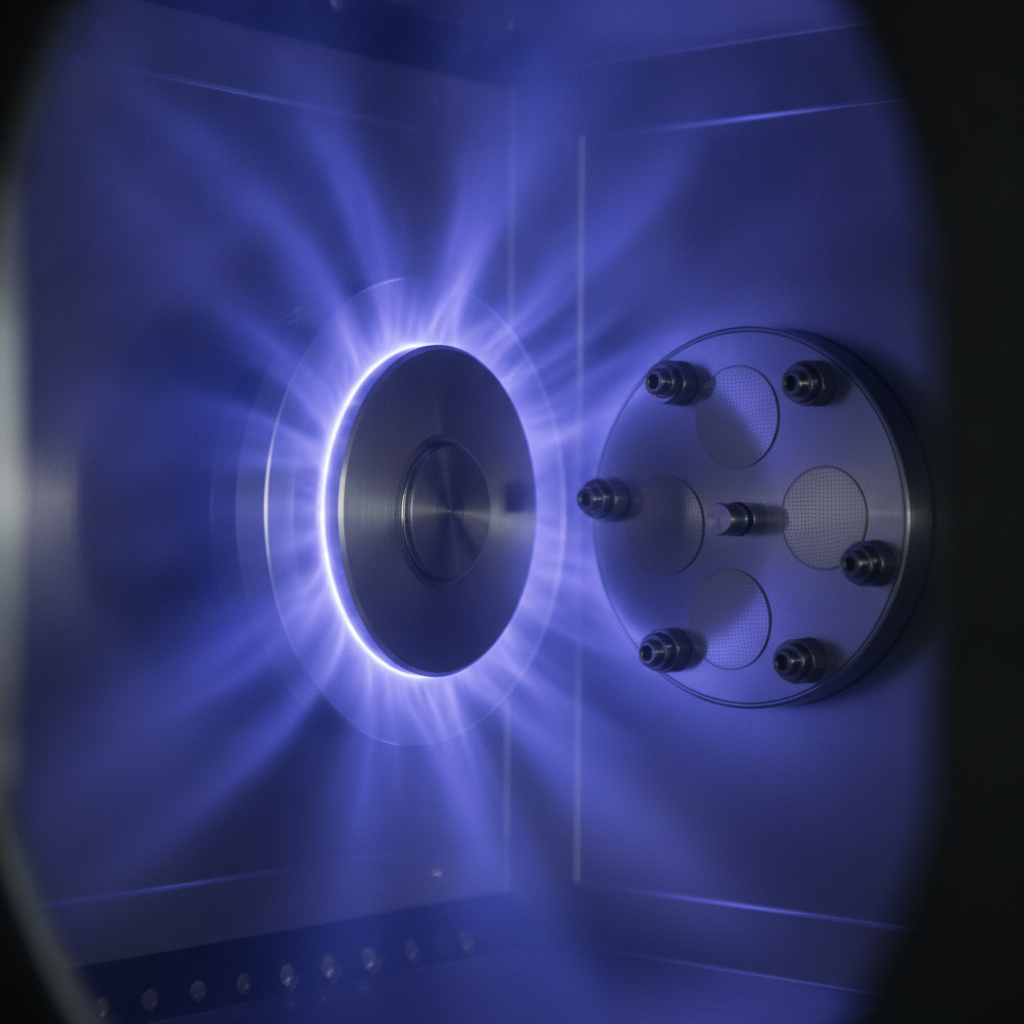
A PVD system evacuates a chamber, energizes a material source (sputter target, arc cathode, or evaporant), and transports atoms through a low-pressure gas to the part. Substrate bias and temperature help atoms densify into a hard, adherent film with engineered composition and thickness.
Although recipes vary, the core workflow follows a reliable pattern. In our experience, the best results come from meticulous preparation and fixture design, followed by repeatable control of power, gas, and motion.
- Preparation and cleaning
- Degreasing, ultrasonic cleaning, and drying remove oils and particulates. Surface prep quality is directly tied to adhesion consistency.
- Microblasting and lapping establish a uniform surface profile before coating. Ra levels are set to match the coating’s duty.
- Loading and fixturing
- Parts mount to rotating fixtures at 3–15 rpm to improve coverage on edges and pockets.
- Thermal mass and spacing are balanced to maintain uniform temperature and flux.
- Vacuum and heat
- Roughing and turbomolecular pumps bring the chamber below 1×10⁻³ Torr quickly; base pressure targets around 1×10⁻⁶ Torr are common to reduce contamination.
- Substrate temperatures for many hard coatings land between roughly 150–450 °C depending on alloy and film.
- Plasma and deposition
- Magnetron sputtering, arc evaporation, or e-beam evaporation generate the vapor flux. Argon establishes the plasma; reactive gases like N2 or C2H2 tailor film chemistry.
- Deposition rates typically range from about 0.1–5 μm/hour depending on the method and targets.
- Cooldown, unload, and QC
- Thickness is verified via calo test or profilometry. Adhesion checks use Rockwell indentation or scratch testing.
- Documentation and serial linking ensure repeatability across batches for regulated customers.
For high-mix, high-volume scenarios, Sputtek’s SPUN series supports cycle capacities up to ~3,000 kg, keeping batch-to-batch conditions steady so you can plan changeovers and line rates with confidence.
Types of PVD systems and methods
The three common PVD approaches are magnetron sputtering, cathodic arc evaporation, and thermal/e-beam evaporation. Each balances density, stress, and deposition rate differently. Selection hinges on your part geometry, base alloy, target coating chemistry, and production cadence.
Choosing the right method is about the engineering trade-offs between film properties and manufacturing realities. Below is a concise comparison that many teams find helpful when scoping trials.
| Method | Key trait | Strengths | Watchouts | Typical uses |
|---|---|---|---|---|
| Magnetron sputtering | Low-droplet, smooth films | Excellent uniformity; good for large loads; versatile reactive chemistries | Lower rate than arc for some stacks | Molds, dies, decorative, functional layers on complex tooling |
| Cathodic arc evaporation | High ionization, high rate | Very dense, tough films; strong adhesion | Macroparticle control needed for fine finishes | Cutting tools, punches, heavy-duty wear surfaces |
| E-beam/thermal evaporation | High purity flux | Great for metals and some multilayers | Line-of-sight limits; stress management | Optical stacks, specialized functional layers |
When edge retention and low friction are paramount, DLC is often the top candidate. For a deeper dive on DLC process mechanics and benefits, explore our DLC coating process overview. If your substrate is stainless, our stainless steel PVD coating guide discusses adhesion and color stability concerns.
Selecting a PVD system and best practices
Select a PVD system by matching chamber size, power topology, pumping speed, and fixturing to your parts, alloys, and target coatings. Prioritize repeatability, in-house prep/post capacity, and quality controls. Plan for maintenance, spare targets, and fixture standardization to stabilize cost per part over time.
Core selection criteria
- Load size and mass: Align chamber volume and turntable load with real batch sizes. Sputtek’s SPUN 2,000 (~1,200 kg) vs. SPUN 4,000 (~3,000 kg) illustrate the impact on takt planning.
- Power and cathode mix: DC/RF magnetrons, arc sources, and bias supplies should match your preferred stacks (e.g., AlTiN, CrN, DLC with interlayers).
- Pumping speed: Turbo and cryo combinations shorten pumpdown and improve gas response—critical for tight multilayer sequencing.
- Software and recipes: Look for versioned recipes, alarms, trend logs, and barcode/lot linkage to keep runs repeatable.
- Pre- and post-processing: Integrated blasting, cleaning, stripping, and lapping close the loop on adhesion and finish.
Engineering best practices we recommend
- Design for coating: Add edge breaks (~0.02–0.05 mm), vent holes on blind pockets, and uniform wall thickness where possible.
- Standardize fixtures: Use common arbors and mask kits to reduce setup minutes and improve coverage consistency.
- Control surface finish: Set incoming Ra/Rz limits by tool class; smoother is not always better—match roughness to film stress and duty.
- Specify inspection: Thickness per surface, adhesion method, and sample size should be on the drawing or PO to avoid ambiguity.
- Plan re-coating: Define strip/recoat criteria tied to geometry loss (e.g., radius or land width) so tooling doesn’t age out prematurely.
Reliability and maintenance cues
- Target life tracking: Replace targets proactively based on amp-hours or weight loss to keep deposition stable from batch to batch.
- Leakup rate checks: A rising leakup after bakeout can indicate seal wear; baseline it by chamber to catch issues early.
- Arc spot management: For arc systems, macroparticle filters and cathode conditioning reduce surface defects on glossy molds.
- Calibration cadence: Verify QCMs, pyrometers, and bias meters at set intervals so thickness and temperature stay inside limits.
Free engineering review: Share one representative tool or component drawing. We’ll propose a fixture approach, a preliminary stack (e.g., CrN/AlTiN/DLC), and a validation plan you can trial in your next maintenance window.
Tools, fixtures, and resources
PVD performance depends on the ecosystem: fixturing, targets, gases, metrology, and prep/post processes. Build a toolkit that keeps adhesion, thickness, and finish in control. Use documented recipes and serial-linked results to validate changes before they reach production tooling.
Tools and resources that pay off quickly are the ones that close feedback loops. Here’s a practical list we deploy on the floor.
- Fixtures and masks: Balanced, modular fixtures with known thermal profiles; reusable masks for sensitive fits and sealing lands.
- Targets and cathodes: Keep spare sets staged (e.g., Ti, Cr, AlTi) with certificates; log amp-hours per target to predict swap timing.
- Process gases: High-purity argon and reactive gases (N2, C2H2) with mass flow verification; trend charts for flow vs. thickness.
- Metrology: Calotesters, profilometers, microhardness, and scratch testing; sampling plans that scale with lot criticality.
- Prep/post: In-house microblasting and lapping ensure consistent starting Ra and final gloss or matte as the application requires.
For perspective on how industrial operations document automation projects, see an example of an automatic coating line portfolio. Differences in polymer behavior versus metals also influence tool choices; a primer on thermoplastic vs. thermosetting materials offers context when your tooling sees many resin families. Broader metals-industry modernization stories, like this manufacturing operations profile, show how process discipline underpins repeatable outcomes.

Case studies and real examples
Real production wins come from pairing the right coating with disciplined prep and fixturing. Below are anonymized scenarios from Sputtek’s work in automotive, molding, machining, and extrusion that show how PVD systems translate into measurable shop-floor results.
Automotive stamping: AHSS pierce punches
- Problem: Premature adhesive wear on ultra-high-strength steel (UHSS) pierce operations causing frequent regrinds.
- Approach: Microblast + CrN/AlTiN stack via arc + sputter; standardized arbor and mask set; thickness targeted ~3 μm on working lands.
- Result: Longer intervals between maintenance events and steadier edge quality across multi-shift runs.
Plastic injection molding: core and cavity release
- Problem: Sticking and surface scuffing on glass-filled resin jobs slowed ejection.
- Approach: Sputtered DLC over Cr interlayer on cores; controlled Ra before and after lapping to balance release with appearance.
- Result: More consistent demolding, with smoother surface condition after extended cycles.
Machining and cutting: carbide end mills
- Problem: Edge rounding and heat damage on long-run aluminum and tool steel programs.
- Approach: AlTiN via cathodic arc with defined preheat; attention to edge prep and flute masking.
- Result: Better edge retention and more stable surface finish over the tool’s life.
Aluminum die cast and extrusion: pins and sleeves
- Problem: Soldering and washout in high-temperature aluminum contact areas.
- Approach: CrN followed by DLC top layer to reduce sticking and thermal damage; tight control of thickness on bearing fits.
- Result: Reduced sticking tendencies and cleaner component condition after runs.
Medical and pharma components: wear and cleanability
- Problem: Surface wear and cleaning challenges on small stainless components.
- Approach: Fine-finish prep, sputtered CrN or DLC as needed; inspection plan scaled to part criticality.
- Result: Improved surface durability with stable appearance across batches.
Frequently Asked Questions
These short answers address the most common questions engineering and production teams ask when they’re evaluating PVD systems, recipes, and workflows. Each answer is concise and designed for quick reference during planning and trials.
What parts benefit most from PVD coatings?
High-wear, high-heat, or galling-prone surfaces benefit most—punches, dies, molds, end mills, reamers, and aluminum contact tools. PVD adds a thin, hard, low-friction layer that protects working edges and release surfaces while preserving base-material tolerances.
How thick should a PVD coating be?
Most tooling films fall around 1–5 μm, tuned to your duty cycle and edge geometry. Thin layers keep sharpness on cutting tools, while slightly thicker builds help on abrasive forming or extrusion surfaces. Specify thickness per surface so critical fits stay within tolerance.
Does PVD change part dimensions?
PVD adds microns, not millimeters. Coatings are thin and conformal, but you should account for buildup on critical fits. Masking, selective coating, or light post-lapping preserves dimensions on bores, sealing lands, and precision gauges.
How do I choose between sputtering, arc, and evaporation?
Match the method to your goal. Choose arc for very dense, tough films on cutting or forming edges; choose sputtering for smooth finishes and precise multilayers on molds and components; consider evaporation for specialized stacks. Your geometry, alloy, and throughput drive the final decision.
Conclusion and next steps
A well-matched PVD system is a production multiplier. Pair robust prep/post processes with the right chamber size, cathodes, and recipes, and you’ll extend tool life, stabilize quality, and protect throughput—without redesigning tooling or changing base alloys.
- Key takeaways:
- Define your coating goal—wear, friction, or release—and pick a method to match.
- Right-size the chamber and fixtures to your real batch mass and geometry.
- Document recipes and inspection so runs are traceable and repeatable.
- Action steps:
- Shortlist candidate stacks (e.g., CrN/AlTiN, AlCrN, DLC with interlayers) for one representative tool.
- Plan a controlled trial: define prep, fixture, thickness, and inspection upfront.
- Review results with our engineering team and lock a standard for production.
Ready to improve wear life and release? Let’s architect a coating workflow tailored to your tools in Woodbridge—leveraging Sputtek’s SPUN series capacity, in-house prep, and certified quality system.