
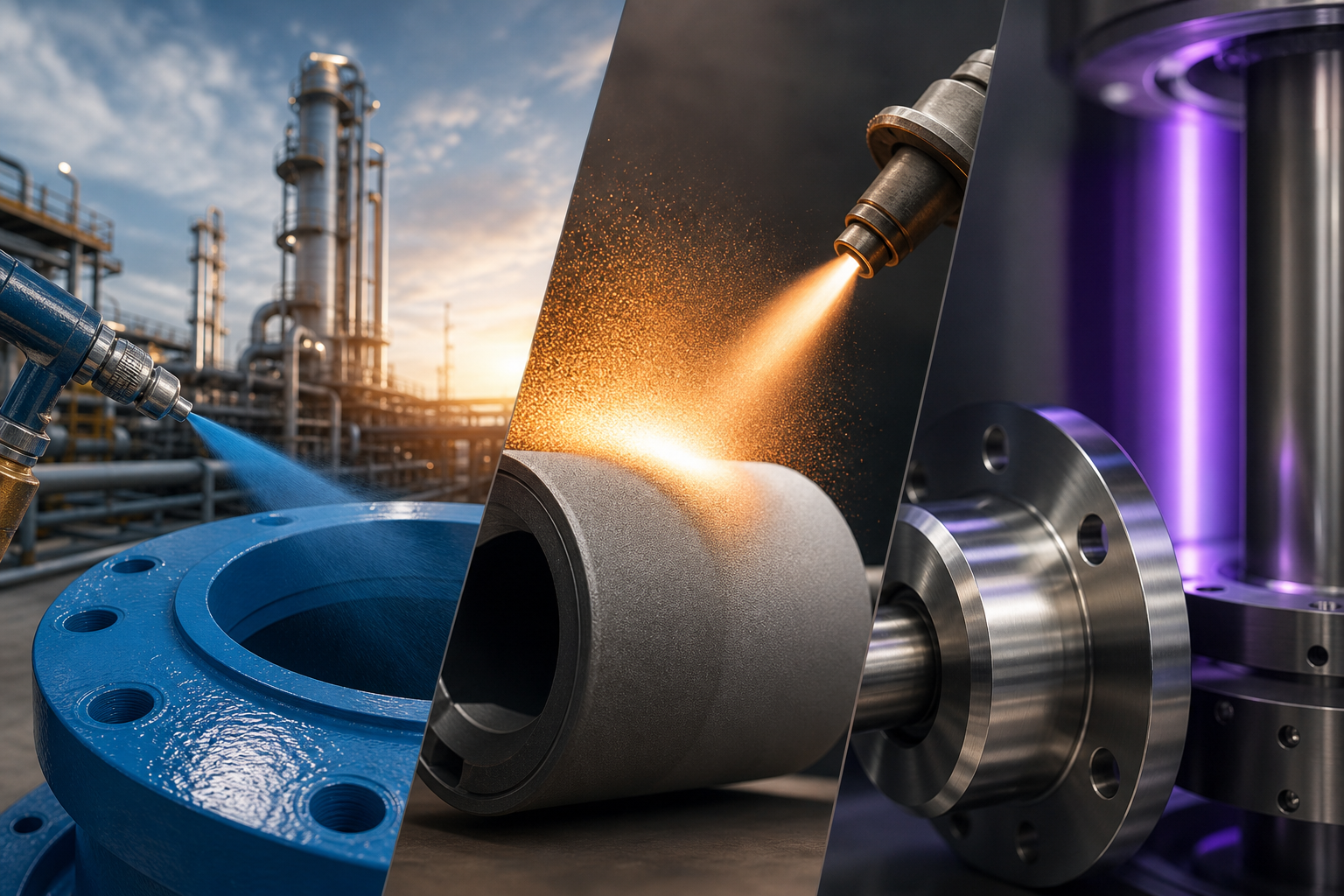
Industrial coatings for corrosion: epoxy vs thermal spray vs PVD
Selecting the right industrial coatings for corrosion starts with three facts: the exposure your part faces, the substrate material, and the dominant failure mode. This article compares the main coating families used in industry—barrier liquid systems, galvanic metallizing, thermal spray and pulsed HVOF, hardfacing, and engineered thin films like PVD and DLC—and maps practical selection criteria, surface preparation needs, standards to reference, and a vendor checklist you can use in the Canada and GTA market.
Quick decision matrix: match environment and substrate to a coating family
Use this matrix to narrow options before you request technical data or trials.
- Atmospheric, nonabrasive corrosion on steel: hot dip galvanizing or an epoxy system with appropriate primers and topcoat.
- Immersion or aggressive chemicals: multi coat epoxy systems, often with a polyurethane topcoat for UV resistance; always validate chemical compatibility with the manufacturer.
- Marine or chloride environments: hot dip galvanizing or zinc/aluminum metallizing, usually combined with barrier coats for long service life.
- Components under combined corrosion and heavy wear: thermal spray or pulsed HVOF metallurgy, or hardfacing when impact and erosion dominate.
- Precision tools and sliding contacts where friction matters: PVD or DLC thin films for low friction and high hardness; pair with other corrosion protection for immersion service.
Standards and corrosion class guidance will change the final choice. See the standards section below for references and how to apply them in specifications.
Barrier liquid systems: epoxy and polyurethane
What they are: multi layer liquid coatings using an anti corrosive primer, intermediate coats, and a topcoat. These systems form a continuous barrier that reduces oxygen and moisture permeability and therefore slows corrosion.
When to choose them: tanks, piping, and assets with continuous immersion or specific chemical exposures. Epoxy resins are common where chemical resistance is primary. A polyurethane or other UV resistant topcoat is often added when UV exposure or abrasion is also a concern. For guidance on matching liquid systems to corrosive environments see this practical overview from industry sources.
Key strengths
- Proven chemical and immersion resistance when the correct resin and cure are selected.
- Cost effective for large surface areas and field application.
- Layered design lets you control total dry film thickness and provide redundancy.
Limitations: liquid systems are vulnerable to heavy abrasion, impact, and combined corrosion plus wear. They can wear through or delaminate under severe mechanical loads. When abrasion or impact is significant, consider metallurgical coatings instead. For a technical comparison of coating types and failures, consult a specialist guide on industrial coating selection. For related first-party details, review Industrial Coatings: The Best Fix for Heavy Wear in.
Galvanic metallizing: zinc and aluminum metallization
What it is: sacrificial or galvanic protection applied as zinc or zinc aluminum layers by hot dip galvanizing or thermal metallizing. These coatings protect steel by corroding preferentially and maintaining protection even when localized damage occurs.
When to choose it: for steel structures, fabricated assemblies, and components exposed to atmosphere or marine environments where galvanic protection is required. Thermal metallization is useful when you must coat assembled elements or need precise local control of thickness. For a technical note on metallization and galvanic protection see an industry guide on protective coatings for steel.
Thermal spray and pulsed HVOF: metallurgical coatings for combined corrosion and wear
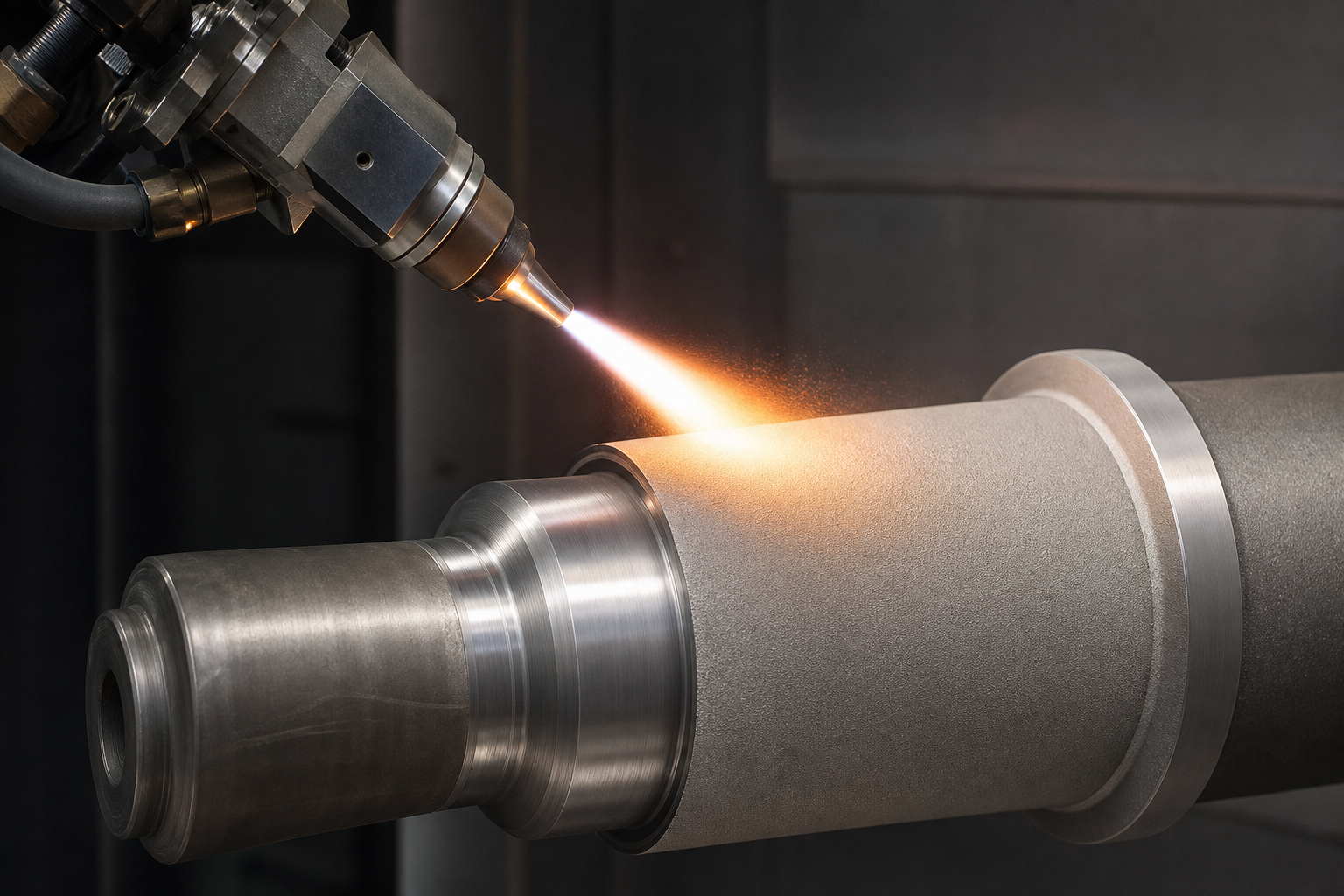
What it is: thermal spray processes, including HVOF and pulsed HVOF, deposit dense metallurgical coatings such as aluminum, zinc aluminum, or alloyed hardfacing blends. These coatings form a metallurgical or mechanical bond to the substrate and can include hard phases or carbides to resist abrasion.
When to choose it: parts that face both aggressive corrosion and heavy mechanical wear, for example plungers, seals, rotating shafts, slurry-transport components, and parts in erosive environments. Thermal spray and pulsed HVOF deliver thicker, tougher coatings that tolerate abrasion without delaminating, making them appropriate where liquid paints fail.
Key strengths
- Strong adhesion and a metallurgical bond improve durability under impact and abrasion.
- Material flexibility: combine sacrificial metals with hard phases for wear resistance and corrosion control.
- Can be applied to assembled components and offers precise thickness control for engineering tolerances.
Practical vendor considerations: thermal spray is process sensitive. Look for in house blasting, strict control of spray parameters, and a QC lab to measure bond strength, porosity, and hardness. For more on when thermal spray is appropriate see an industry comparison of coating types and uses.
Local example: service providers in the Greater Toronto Area that integrate thermal spray with in house surface preparation and lapping reduce transfer risk and speed trials to production. For a local service overview, review regional industrial coatings pages that describe combined capabilities.
Hardfacing and weld overlays: when extreme abrasion accompanies corrosion
What it is: deposition of wear resistant alloys by welding or surfacing processes to build a thick, hard overlay on the substrate. Hardfacing is used where impact, sliding abrasion, or erosive wear cause rapid material loss.
When to choose it: mining equipment, heavy processing chutes, and parts with severe erosion or impact. Hardfacing offers long service life under extreme mechanical loads but can introduce distortion and requires skilled welding and metallurgical control. Choose hardfacing when periodic rebuilds are acceptable and when other coatings cannot maintain integrity under continuous heavy wear.
PVD and DLC thin films: corrosion resistance, friction control, and limits
What they are: engineered thin films deposited by physical vapor deposition or diamond like carbon processes. These coatings are thin and dense, delivering low friction, high hardness, and excellent adhesion when applied to well prepared tooling steels and precision parts.
When to choose them: precision tooling, cutting tools, valves, and sliding components where wear reduction and friction control are priorities. PVD or DLC are not usually standalone solutions for heavy corrosion or immersion service because their thickness is small and they do not provide sacrificial protection. However, they are highly effective in hybrid approaches, for example PVD on tooling combined with a barrier or metallized substrate where necessary. For PVD use cases and limitations consult technical references on engineered thin films.
Compare and choose: decision criteria and a buyer checklist
Objective criteria to evaluate coating families and vendors
- Exposure class: use ISO 12944 or equivalent industry guidance to classify atmospheric and immersion risk and to map exposure to system requirements. Standards convert exposure into expected system thickness and layer schemes; include the exposure class in procurement documents.
- Substrate compatibility: assess galvanic risk and metallurgical compatibility, especially when combining dissimilar metals or overlays.
- Mechanical load and abrasion: if abrasion or impact is dominant, prefer metallurgical coatings or hardfacing rather than barrier paints.
- Required thickness and tolerances: thermal spray and metallizing provide controlled thicknesses suited to engineering fits; liquid systems may be preferable for large, low-tolerance surfaces.
- Repairability and maintenance: sacrificial or metallurgical coatings are often more repairable in the field than thin films.
- Proof and traceability: require material data sheets, test reports for salt spray or cyclic corrosion, adhesion, porosity, and hardness, and examples of similar projects.
Technical data and trial conditions to request from vendors
- Coating materials and specification sheets, including TDS and MSDS.
- Test reports: salt spray or cyclic corrosion, adhesion pull tests, hardness, bond strength, and porosity when relevant.
- Surface preparation records: blast cleanliness level, anchor profile, preheat, and peening steps where applicable.
- Sample trial protocol: number of samples, specified environmental conditions, and objective pass fail criteria tied to measurable limits.
- Turnaround, batch capacity, and historical pilot-to-production scaling examples.
For practical comparisons of coating families and failure modes consult technical overviews from established industry resources that review coating selection and protective strategies.
Standards, surface preparation, and inspection that make coatings last
Coating longevity begins with correct exposure classification and surface preparation. Use ISO 12944 to assign atmospheric exposure classes and to translate that class into a coating system. Typical NACE or AMPP surface preparation levels and inspection items to specify include blast cleanliness and profile, adhesion pull test results, coating thickness mapping, and porosity assessments. Require documented inspection records and sample test reports in purchase orders so acceptance is measurable and repeatable. For guidance on standards and specification practice see industry technical references on protective coatings for corrosion control.
Choosing a vendor in Canada and the GTA: certifications, capacity, and proof points
Local vendor checklist
- Quality certifications such as ISO 9001:2015 and any sector approvals you require, for example nuclear vendor approvals for nuclear components.
- In house surface preparation and post processing, including sandblasting, microblasting, cleaning, stripping, polishing, and lapping to avoid fragmented workflows.
- QC laboratory and test capability for adhesion, porosity, hardness, and corrosion testing.
- Prototype to volume capability and machine capacity that match your batch sizes and lead time expectations.
- Relevant references and case examples that demonstrate comparable service conditions.
Sputtek operates an advanced metallurgical surface treatment facility in the Greater Toronto Area and provides PVD, thermospray including pulsed HVOF, and end to end in house preparation and QC. For a local service overview and capacity information visit Sputtek’s industrial coatings page.
Minimal three step trial plan you can run next week
- Define exposure and acceptance criteria, including ISO 12944 exposure class or specific chemical, temperature, and mechanical demands.
- Request vendor data and a small sample trial: ask for TDS, MSDS, relevant test reports, and one or two parts coated to the nominated process with documented surface prep records.
- Run specified lab and short field tests, compare measured adhesion, thickness, and corrosion results against acceptance criteria, then scale to a pilot batch if results meet your limits.
Frequently asked questions
Which coating family is best for immersion or continuous chemical exposure?
Multi coat epoxy systems are typically recommended for immersion and continuous chemical exposure because they create a continuous chemical barrier. A polyurethane or similar topcoat may be added for UV and abrasion resistance. Always validate chemical compatibility with the manufacturer technical data and test reports.
When should I choose thermal spray or pulsed HVOF instead of an epoxy paint system?
Choose thermal spray or pulsed HVOF when the part faces combined corrosion and heavy abrasion or impact. Liquid paints often delaminate or wear through under severe abrasive loads, while metallurgical thermal spray delivers a tougher, more repairable layer that tolerates mechanical stress.
Can PVD or DLC coatings replace galvanic protection for steel in marine environments?
No. PVD and DLC are engineered thin films that reduce friction and improve wear, but they do not provide sacrificial galvanic protection. For steel in marine or chloride rich environments, galvanizing or metallizing is the appropriate approach for long term corrosion protection.
What surface preparation and inspection records should I require from a coating vendor?
Require blast profile and cleanliness records, adhesion pull test results, coating thickness maps, porosity measurements when relevant, and the vendor’s test reports for salt spray or cyclic corrosion testing tied to your acceptance criteria.
What technical data and trial conditions should I request to validate a corrosion coating for production?
Ask for material data sheets, TDS and MSDS, lab test reports for corrosion resistance, adhesion, hardness, and porosity, and a documented trial protocol that defines samples, test environments, and the pass fail criteria you will use to accept the process for production.
Ready to discuss your part and the right coating family for its environment? Contact Sputtek to request technical details, sample trials, and a production scalable solution tailored to your substrate and exposure profile. For additional technical background on coating selection and corrosion control, review industry resources that cover standards, metallizing, and thermal spray options.