
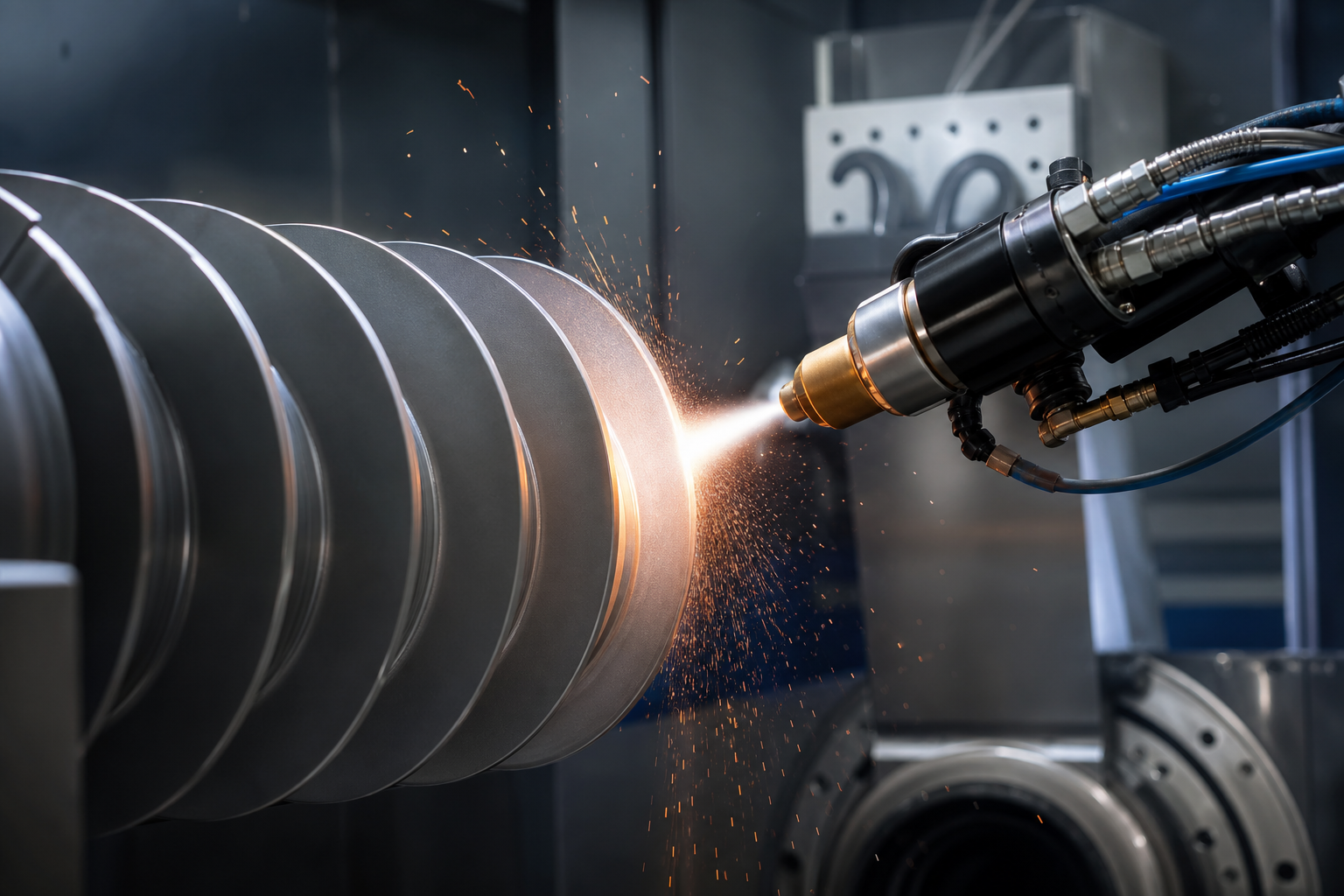
A Practical Guide to Thermal Spraying Coating
Thermal spraying coating is a versatile surface engineering family of processes that deposits metals, alloys, ceramics, and cermets onto a substrate to enhance wear resistance, reduce friction, improve corrosion protection, or restore dimensions. This guide explains how thermal spraying works, outlines major process types, and provides practical frameworks, checklists, and decision points you can use to evaluate, specify, and validate a coating for your application.
What is thermal spraying coating?
In thermal spraying, a feedstock material (powder or wire) is heated to a molten or semi-molten state and propelled toward a prepared surface by a high-velocity gas stream. The particles impact the substrate and rapidly solidify to form a lamellar coating. Unlike diffusion-based or vacuum deposition methods, thermal spray builds relatively thick coatings at high deposition rates without melting the substrate.
Engineers consider thermal spraying when they need one or more of the following:
- Wear resistance for sliding, abrasion, or erosion conditions
- Corrosion or oxidation protection
- Thermal barriers and controlled emissivity
- Electrical insulation or conductivity
- Dimensional restoration of worn or out-of-tolerance parts
- Bond coats and build layers for subsequent finishing
How thermal spraying works
All thermal spray processes share the same building blocks, even though the heat sources and particle velocities vary:
- Surface preparation: Cleaning, degreasing, masking, and mechanical roughening (commonly grit blasting) to create an anchor profile for coating adhesion.
- Heating and acceleration: A combustion flame, electric arc, plasma, or high-pressure combustion jet heats the material and accelerates it toward the component.
- Particle impact and solidification: Molten droplets flatten into splats and rapidly solidify, creating a lamellar microstructure.
- Layer build-up: Successive passes build thickness to the specified target. Post-processing can include sealing, grinding, polishing, or lapping to final geometry and surface finish.
- Inspection and validation: Coating thickness, adhesion, porosity, hardness, roughness, and appearance are evaluated against the specification before release.
Major thermal spray processes
Choosing a process depends on the required coating properties, allowable heat input to the substrate, geometry, and cost targets. Below is a practical overview of common options.
- Flame spray (powder or wire): Uses a combustion flame to melt feedstock and a gas stream to propel it. Suitable for general-purpose build-ups and corrosion coatings with moderate bond strengths and relatively higher porosity compared to denser processes.
- Electric arc spray (wire): Two consumable wires form an arc; molten metal is atomized by air or gas. Good for metallic coatings at high deposition rates, often used for dimensional restoration and corrosion protection.
- Plasma spray (APS): An ionized gas jet (plasma) melts powders at very high temperatures. Broad material compatibility (including ceramics) and good control of microstructure; commonly used for wear-resistant and thermal barrier coatings.
- HVOF (High Velocity Oxy-Fuel): A high-pressure combustion jet accelerates semi-molten particles to supersonic velocities, producing dense, well-adhered coatings with low oxide content. Frequently selected for carbide-based wear coatings and corrosion-resistant alloys.
- Detonation gun (D-gun): Intermittent detonation waves propel particles at very high velocities, generating very dense coatings with strong adhesion; typically used for hard, wear-resistant layers.
- Cold spray: Particles remain solid and bond via severe plastic deformation at high velocities. Useful for oxidation-sensitive materials and dimensional build-up where minimal heat input is desired.
Common coating materials
Thermal spraying accommodates a wide range of feedstocks. Selection should be driven by the operating environment and target properties.
- Carbides: WC-Co, WC-CoCr, Cr3C2-NiCr for abrasive wear, erosion, and sliding contact.
- Cermets: Hard phase in a metallic binder, balancing toughness and hardness.
- Ceramics: Al2O3, Al2O3-TiO2, Cr2O3, ZrO2-based for insulation, corrosion resistance, or thermal barriers.
- Metals and alloys: Ni-based, Co-based, stainless steels, aluminum, copper, bronze for corrosion protection, restoration, and functional properties.
- Bond coats: NiAl, NiCrAlY to promote adhesion and manage thermal expansion mismatches.
- Specialty formulations: Tailored blends for specific friction, electrical, or tribological targets.
Selection framework: matching process and material to the job
Use this structured approach to converge on a robust coating stack and process route.
-
Define the duty cycle:
- Dominant failure mode: abrasion, adhesion, erosion, corrosion, fretting, galling, oxidation, thermal cycling
- Operating window: temperature range, contact pressures, speeds, impact/particle size for erosion
- Environment: pH, chlorides, humidity, gases, contamination, cleaning agents
-
Set measurable targets:
- Minimum coating thickness range (and tolerances)
- Surface roughness before/after finishing
- Adhesion test method and acceptance (e.g., tensile bond per defined standard)
- Porosity range, oxide content, hardness or microhardness method
-
Screen process candidates:
- Need for high density and low oxide? Consider HVOF or detonation gun.
- Need ceramics or thermal barriers? Consider plasma spray.
- Dimensional restoration with metallics? Consider arc spray or flame spray.
- Minimal heat input? Consider cold spray (if material is amenable).
-
Pair with materials:
- Abrasive wear at moderate temps: WC-based carbides via HVOF.
- High-temp corrosion/oxidation: Ni- or Co-based superalloy powders via plasma or HVOF.
- Electrical insulation: Al2O3 or Al2O3-TiO2 via plasma.
- Dimensional build: stainless or Ni alloys via arc/flame; seal and finish to size.
-
Validate manufacturability:
- Geometry access, line-of-sight, masking feasibility
- Substrate sensitivity to heat; preheat/fixturing needs
- Throughput, batch size, and cost constraints
-
Pilot and qualify:
- Coupon trials to lock parameters and acceptance ranges
- Correlation between lab tests and real-world wear/corrosion mechanisms
- Documentation: procedures, traveler, and inspection plan
Design for coating: geometry, prep, and finishing
Good outcomes start with design details that simplify preparation, deposition, and finishing.
- Geometry: Favor line-of-sight access; avoid deep recesses and sharp internal corners. Provide runouts for blending and finishing tools.
- Masking strategy: Define protected surfaces, edges, and threads; specify allowable overspray and removal methods.
- Surface preparation: Call out cleaning method, media, roughness range (Ra/Rz), and maximum time-to-spray after blasting.
- Bond coats: Where dissimilar CTEs or challenging substrates are present, include a bond layer to manage adhesion and residual stresses.
- Thickness and finishing allowances: Specify as-sprayed thickness and grind stock so final dimensions and surface finish are achievable without over-thinning.
- Edges and radii: Chamfer or radius edges to reduce stress concentration and improve coverage uniformity.
Specification building blocks and example structure
Clear, testable specifications reduce ambiguity and speed up qualification. Consider structuring your spec with these elements:
- Scope and part identification: Drawing numbers, revision, material, and heat treatment state.
- Coating stack: Bond coat and topcoat materials, feedstock form (powder/wire), target compositions.
- Process route: Thermal spray method, preheat limits, interpass temperatures, cooling approach.
- Thickness: Nominal, min/max, and locations for measurement.
- Surface finish: As-sprayed and post-finish Ra/Rz targets, flatness/roundness where relevant.
- Masking: Protected features and acceptable witness lines.
- Inspection and testing: Methods for adhesion, porosity, hardness, and microstructure; sample size and frequency.
- Accept/reject criteria: Quantitative thresholds for each measured attribute.
- Documentation: Certificates of conformity for feedstock, process records, test reports.
- Packaging and handling: Cleanliness, protection of finished surfaces, and storage conditions.
Quality control and testing
Verification should align with criticality and risk. Typical checks include:
- Thickness: Magnetic, eddy-current, or ultrasonic gauges; metallographic cross-sections for development and periodic validation.
- Adhesion: Tensile bond or standardized pull-off tests, with defined fixtures and surface prep.
- Porosity and microstructure: Polished cross-sections evaluated by image analysis to quantify porosity and oxides; confirm lamellar structure and bond coat integrity.
- Hardness: Microhardness on mounted samples or macrohardness where applicable.
- Roughness: Profilometry before and after finish grinding/polishing to verify functional targets.
- Appearance: Visual inspection for unmelted particles, overspray, cracks, discoloration beyond the specification.
Common pitfalls and mitigations
- Poor adhesion: Tighten cleanliness controls; adjust blast media and profile; consider a bond coat; verify substrate preheat and interpass temperatures.
- Excessive porosity: Optimize standoff distance, feed rate, and energy; evaluate a denser process such as HVOF or detonation gun for demanding applications.
- Oxidation/contamination: Control gas quality and flow; minimize particle dwell time at temperature; review shielding and nozzle condition.
- Distortion or thermal damage: Reduce heat input, modify pass strategy, use fixturing or cooling; consider processes with lower substrate heating.
- Non-uniform thickness: Program consistent gun angles and traverse speeds; rotate or index complex parts to maintain line-of-sight and overlap.
- Finishing difficulties: Plan grind stock and specify compatible abrasives; include sealing steps where needed to stabilize the surface before final finishing.
Maintenance and lifecycle considerations
Coating performance depends on proper handling and maintenance after installation:
- Break-in and mating surfaces: Verify counterface finishes and lubricants meet specification; improper mating can accelerate wear.
- Cleaning protocols: Use approved solvents and tools that will not glaze, embed, or chemically attack the coating.
- Inspection intervals: Define visual checks and dimensional audits based on duty cycles to catch early degradation.
- Refurbishment: For build-up applications, plan strip-and-recoat routes that protect the substrate and critical fits.
Documentation and traceability checklist
For repeatable outcomes, maintain a clear paper trail:
- Feedstock batch certifications and storage conditions
- Equipment calibration and maintenance records
- Parameter windows (gun speed, standoff, gas flows, temperatures)
- Operator qualifications and process travelers
- In-process and final inspection reports with acceptance results
Frequently asked questions
How thick can a thermal spray coating be?
Thickness depends on the process and material. Many functional coatings are specified from tens of micrometers up to several millimeters for build-ups. Define target thickness and tolerances early and confirm with your coating provider’s process capabilities.
Can thermal spray be applied to heat-sensitive parts?
Several methods allow controlled heat input. Options like cold spray or carefully managed pass strategies can help. If the part has strict heat limits, note allowable interpass temperatures in the specification and validate with trials.
Do I need a bond coat?
Bond coats improve adhesion and help accommodate thermal expansion differences, especially with ceramics or on challenging substrates. Many specifications include a bond layer beneath the functional topcoat to stabilize the interface.
What finishing is required after spraying?
That varies by application. Some coatings are used as-sprayed, while many require grinding, polishing, or lapping to achieve final dimensions and surface finish. Include finishing allowances in your drawing and verify achievable Ra/Rz.
How do I compare HVOF to plasma spray?
HVOF typically produces dense metallic and carbide coatings with high particle velocities and low oxide content, making it a strong choice for wear and corrosion resistance. Plasma spray offers extremely high temperatures and is well-suited to ceramics and thermal barriers. The best fit depends on your property targets and material choice.