
Stainless steel with PVD coating is stainless substrate enhanced by a micrometer-thin, vacuum-deposited ceramic or carbon film that raises hardness, lowers friction, and improves corrosion and color stability. For Woodbridge manufacturers, it delivers longer tool life, smoother release, and fewer changeovers on the same stainless base—without redesigning parts.
By Ron — Sputtek | Last updated: 2026-06-23
Overview and table of contents
This guide explains how PVD films transform stainless steel performance for tooling and components. You’ll learn definitions, mechanisms, film types, best practices, QA steps, and real manufacturing examples from Sputtek’s Woodbridge operations, plus a quick decision framework and a comparison table versus other surface treatments.
In fast-moving plants, details matter. Here’s what you’ll get in a few minutes of focused reading:
- Clear definition of stainless steel with PVD coating and why it matters now
- How PVD adheres to stainless, typical thickness (1–10 micrometers) and hardness (often up to ~3,000 HV)
- Film families: TiN, TiCN, CrN, ZrN, multilayers, and DLC variants
- Where it wins: stamping, plastic molds, cutting tools, and precision components
- Design-for-coating checklist and QC checkpoints you can operationalize
- Local considerations for Woodbridge teams coordinating runs and logistics
What is stainless steel with PVD coating?
Stainless steel with PVD coating is a stainless substrate protected by a thin, dense ceramic or carbon film deposited in vacuum. The film typically measures 1–5 micrometers, achieves roughly 1,500–3,000 HV microhardness, and lowers friction to about 0.05–0.4 depending on chemistry, delivering wear, galling, and corrosion advantages without altering core dimensions.
Plain stainless excels at corrosion resistance, but galling, adhesive wear, and friction can limit uptime. A PVD film adds a hard, inert barrier with engineered surface energy. Practical implications:
- Wear resistance: Dense films resist abrasion; tool edges hold geometry longer.
- Lower friction: Coefficients can drop from about 0.4–0.6 (bare) to roughly 0.05–0.3 (DLC/CrN/TiCN), reducing heat and sticking.
- Thermal stability: Many nitride films maintain properties up to about 500–560 °F (260–293 °C).
- Color and finish control: Gold (TiN), champagne (ZrN), deep gray/black (DLC) improve branding and glare control.
At Sputtek’s modern GTA facility, we coat prototypes through large batches in SPUN-series PVD systems with capacities up to approximately 3,000 kg per cycle, pairing stainless substrates with film chemistries that match actual loads and temperatures in service.
Why PVD on stainless matters now
PVD on stainless boosts uptime, quality, and regulatory fit without redesigning tools. Plants report fewer changeovers, cleaner release, and steadier dimensions because films are thin (1–10 micrometers) yet hard (above 1,500 HV) and low-friction (around 0.3 to 0.05), aligning with lean, validated lines.
For engineering and operations teams, benefits show up in the KPIs you track daily:
- Uptime and OEE: Lower friction means cooler runs and less adhesive wear, so preventive intervals can stretch safely.
- Yield stability: Edges stay crisp; flash and burrs decline, supporting tighter capability indices.
- Regulatory confidence: In food and medical tooling, inert films reduce transfer risk and simplify cleaning validation.
- Sustainability: Extending tool life by even 2–5× reduces scrap stainless and transport emissions tied to regrinds.
We see the biggest wins where stainless already performs well for corrosion, but friction and galling were the constraint. PVD lifts that ceiling with a controllable, repeatable surface function, validated under ISO 9001:2015 and Nuclear N299.3 quality frameworks in our shop.
How PVD bonds to stainless
PVD bonds by atomically condensing vaporized metals or carbon onto a cleaned stainless surface in high vacuum. Ion bombardment activates the surface, promotes nucleation, and creates a dense film with strong adhesion. Sputtek uses arc, sputter, and hybrid recipes to tune stress, density, and roughness.
Although the physics are elegant, the path to repeatable adhesion is decidedly practical. In our process chain:
- Preparation matters: In-house degreasing, sandblasting or microblasting, ultrasonic cleaning, and vacuum bake-out strip films to the base metal.
- Plasma activation: A glow discharge removes the last monolayers of contamination and seeds nucleation.
- Adhesion layer: A nanometric metallic interlayer (for example Cr/CrN) accommodates lattice mismatch and reduces residual stress.
- Growth control: Arc evaporation delivers high ionization for dense columns; magnetron sputtering provides smoother, stress-controlled films.
Deposition temperatures often run 350–380 °F (175–193 °C) for nitrides and lower for some DLC variants, protecting heat-treated stainless. Typical thickness is 2–5 micrometers for tools; components may use under 1 micrometer decorative-functional stacks where tight tolerances drive decisions.
Types of films for stainless steel
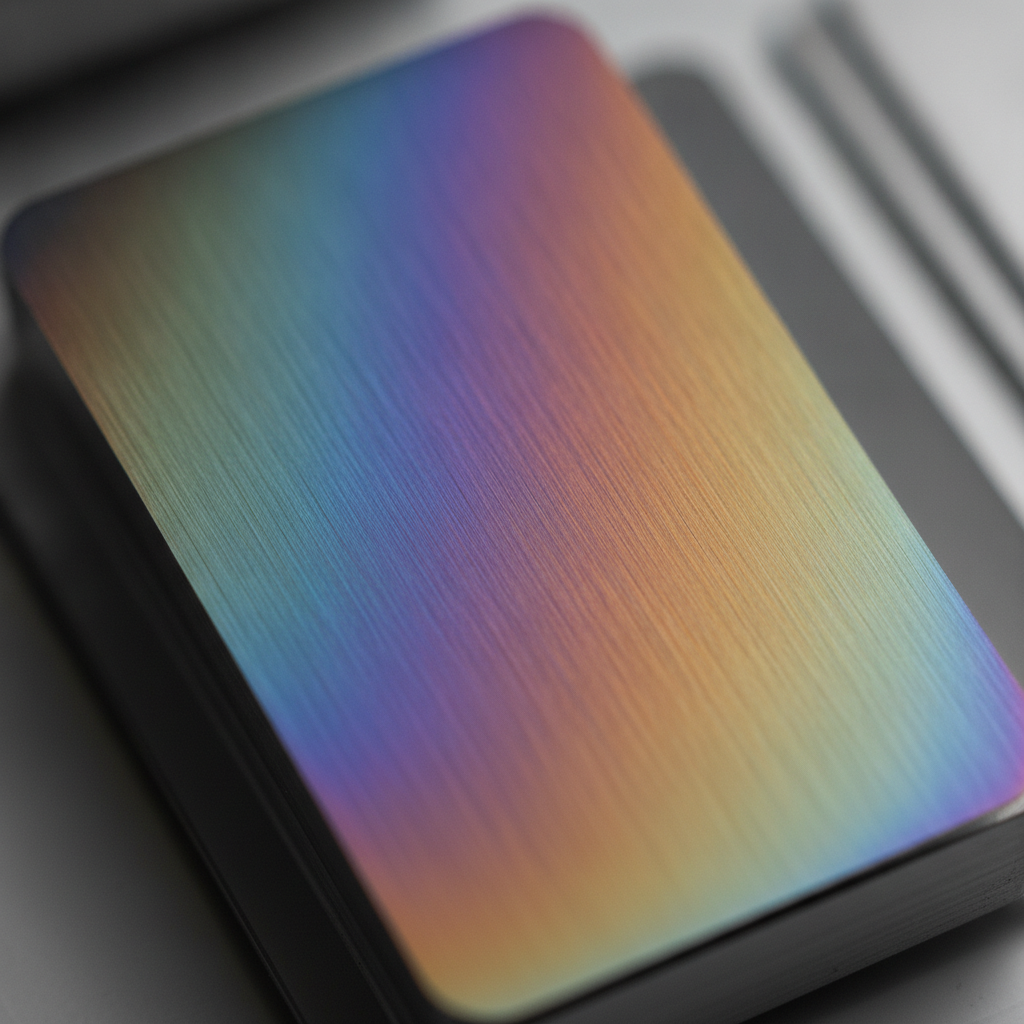
Common PVD films on stainless include TiN (gold), TiCN (hard, lubricious), CrN (corrosion-tough), ZrN (warm champagne), multilayers for crack deflection, and DLC for ultra-low friction (near 0.1). Selection depends on load, temperature, chemistry exposure, and cleanability requirements.
Core nitride and carbide families
- TiN: Approximately 1,800–2,500 HV, friction about 0.4–0.6, stable to around 900 °F (482 °C). Popular for visual gold tone and general wear protection.
- TiCN: Roughly 2,000–2,800 HV, friction about 0.25–0.4. Added carbon improves lubricity and edge retention on shearing tools.
- CrN: About 1,500–2,000 HV, friction about 0.3–0.6, excellent for corrosion and galling control on stainless.
- Pairs well with 300/400 series stainless; often used on mold inserts and valves.
- ZrN: About 2,000–3,000 HV, warm color, good for food-contact visibility where scratch-hiding and cleanability matter.
DLC and carbon-rich stacks
- DLC (diamond-like carbon): Friction as low as about 0.05–0.15, high inertness, ideal for sliding and dry-running interfaces.
- Metal-DLC hybrids: Tailor adhesion and residual stress for complex geometries and thermal cycles.
Multilayers and gradients
- Multilayer stacks: Alternate harder and tougher layers (for example TiN/CrN) to deflect cracks and resist spalling under impact.
- Graded interfaces: Smooth the transition from stainless to hard ceramic to mitigate thermal and elastic mismatch.
For deeper chemistry context and design levers, see our physical vapor deposition guide and this focused DLC coating explainer.
Applications where it wins
PVD-coated stainless shines in stamping (less galling), plastic molds (easier release), cutting tools (cooler edges), and precision components (stable dimensions). Real plants report cleaner parts and longer intervals between maintenance when film chemistry matches load and temperature.
Stamping and forming
- Problem: Stainless-on-stainless galling raises friction and seizures under high contact pressure.
- Solution: CrN or TiCN on stainless dies and blanking tools; friction near 0.25–0.4 supports smoother draw.
- Result: Interface temperatures trend lower and unplanned pulls decline significantly in monitored trials.
- Next step: Explore our stainless PVD overview for die-specific tips.
Plastic processing molds
- Problem: Sticking, drag marks, and frequent release-agent use slow cycles and complicate cleaning validation.
- Solution: DLC or ZrN on cores and cavities; friction around 0.05–0.2 reduces agents and residue.
- Result: Shorter cooling windows and improved cosmetics, especially on glossy consumer surfaces.
- Next step: Our PVD finishing guide covers polish and microtexture pairing.
Machining and cutting
- Problem: Heat and notching limit edge life on stainless machining; coolants can’t fix poor tribology.
- Solution: TiCN or DLC on stainless blades and cutters; films run cooler and stay sharper.
- Result: Edge radius growth slows measurably beyond the first day of continuous production, stabilizing finish.
- Next step: See our high-performance coatings overview.
Precision components
- Problem: Cosmetic scratching and micro-wear on handles, valves, and surgical components.
- Solution: TiN or ZrN for color and scratch resistance; CrN for galling control in assemblies.
- Result: Visible defect rates drop and cleaning becomes more predictable.

Local considerations for Woodbridge
- Coordinate pickups near SmartCentres Woodbridge to streamline pallet transfers during shift changes.
- Plan coating runs around summer humidity spikes; consistent pre-bake and vacuum timing preserve adhesion.
- Use the Weston Rd / Highway 7 corridor for quick courier access when turning urgent prototype lots.
Process: step-by-step workflow
A robust PVD-on-stainless workflow includes incoming inspection, precision cleaning, masking and fixturing, plasma activation, deposition (arc, sputter, or hybrid), and post-process QC (thickness, adhesion, roughness). Each step protects adhesion and delivers repeatability across batches and complex geometries.
- Incoming inspection: Verify alloy, heat treatment, and finish (for example, Ra 0.05–0.4 micrometers typical for tools). Identify critical edges and sealing surfaces.
- Cleaning and surface prep: Degrease, ultrasonics, DI rinse, microblast as needed. Target a clean, activated surface with no embedded media.
- Masking and fixturing: Define no-coat zones and maintain line-of-sight in the chamber. Fixturing angles affect thickness uniformity (about ±0.2–0.5 micrometers tolerance typical).
- Plasma activation: Remove final residues; bias the part to attract ions.
- Deposition: Select arc for high ionization and density; sputter for smoother, stress-managed films; or hybrid for complex stacks.
- Post-process: Bake-out, cool-down, demask, clean; optional lapping or polish for target Ra and visual grade.
- QC and documentation: Thickness (calo test or XRF), adhesion (Rockwell indentation), roughness (profilometer), and visual. Record recipes, lot traceability, and nonconformance handling.
For teams building internal playbooks, our PVD plating overview outlines deposition families inside the broader Deposition pillar.
How it compares to alternatives
Compared with nitriding or electroplating, PVD delivers higher hardness, thinner films, better color control, and strong adhesion on stainless with modest thermal input. It preserves tolerances and dimension-critical fits while providing targeted tribology improvements.
| Treatment | Typical hardness | Thickness | Process temp | Corrosion impact | Color/finish | Notes |
|---|---|---|---|---|---|---|
| PVD (TiN/TiCN/CrN/DLC) | ~1,500–3,000 HV | 1–5 micrometers | ~175–193 °C | Neutral to improved | Engineered colors | High adhesion; low friction |
| Nitriding (ion/gas) | ~700–1,200 HV | 5–100 micrometers | ~350–500 °C | Variable | Gray matte | Deeper diffusion; dimensional change risk |
| Electroplating (Cr/Ni) | ~800–1,000 HV | 5–50 micrometers | Ambient | May create galvanic couples | Mirror to satin | Chemistry and waste considerations |
Best practices for design and prep
Design for coating by controlling finish (Ra), rounding edges slightly, and specifying no-coat zones. Prep thoroughly, fixture for line-of-sight, and document recipes. These steps stabilize adhesion, thickness, and friction so coated stainless performs as modeled.
Design for coating (DfC)
- Specify finish: For molds, Ra 0.05–0.2 micrometers reduces transfer; for blades, micro-lapping controls bite without micro-chipping.
- Ease edges: A 0.02–0.05 mm edge radius supports film wrap and crack resistance at high contact stress.
- Protect fits: Call out critical diameters and plan masking to preserve interference and sliding fits.
Preparation and fixturing
- Cleanliness is binary: Any oil or embedded media becomes a weak point; closed-loop cleaning, DI rinses, and vacuum bake-outs are non-negotiable.
- Fixturing angles: Aim for consistent line-of-sight; rotate where possible to balance thickness.
- Masking strategy: Define datum features; protect threads and seal lands with temperature-stable masks.
Documentation and QA
- Recipe control: Lock bias voltage, pressure, and target currents; document for repeat lots.
- Acceptance criteria: Thickness within ±0.5 micrometers tolerance, adhesion class by Rockwell C indent, and cosmetic grade tied to function.
- Traceability: Lot records support audits in regulated sectors (medical, nuclear, food).
Quality control and testing
Verify PVD on stainless with thickness (XRF or calo), adhesion (Rockwell indent), roughness (profilometer), hardness (microindentation), and friction checks. Pair metrology with run cards, photographs, and lot traceability for audit-ready documentation.
- Thickness: XRF spot checks or calo (ball-crater) mapping target 1–5 micrometers typical.
- Adhesion: Rockwell C indentation evaluates cracking or spall patterns against a known class.
- Hardness: Vickers or Knoop microhardness tracks film consistency (above 1,500 HV for many nitrides).
- Roughness: Profilometry pre and post ensures functionally critical Ra values are preserved.
- Friction and wear: Pin-on-disk and real-part trials align lab data with field loads and lubricants.
Our ISO 9001:2015 and Nuclear N299.3 controls formalize travelers, acceptance criteria, and nonconformance management—useful where validation evidence is required.
Tools and capabilities at Sputtek
Sputtek’s Woodbridge operation runs multiple PVD systems (SPUN 2,000 and SPUN 4,000), a Thermospray cell, and full in-house prep and post-processing. We scale from single prototypes to multi-thousand-kilogram cycles with tight QC, short loops, and engineering support.
- High-capacity PVD: SPUN 2,000 handles up to about 1,200 kg per cycle; SPUN 4,000 up to roughly 3,000 kg per cycle for large batches.
- Process breadth: Arc, sputter, and hybrid films; nitride, carbide, carbon (DLC) stacks; decorative-functional combinations.
- In-house chain: Sandblasting, microblasting, stripping, cleaning, lapping, and a QC lab keep quality consistent.
- Thermospray (Pulsed HVOF): When thickness above 50 micrometers or impact damping is needed, we deploy thermal spray in the same facility.
- Engineering-led: Coating recipes and fixturing are tuned by an R&D-driven team used to regulated industries.
For teams comparing film families, our DLC services guide dives into carbon variants, while the broader high-performance coatings page summarizes cross-industry plays.
Case studies and scenarios
Across stamping, molding, and cutting, coated stainless stabilized throughput and surface quality. The common thread: match chemistry to load and validate with short trial loops. Here are anonymized scenarios reflecting typical results we see in Woodbridge runs.
Automotive stainless stamping rails
- Context: Progressive dies in 400-series stainless suffered galling every 15–20 shifts.
- Intervention: CrN on draw beads and TiCN on cutting edges; finish controlled to around Ra 0.2 micrometers.
- Outcome: Pull-outs dropped noticeably and changeover intervals extended; dimensional scatter tightened.
Pharma-grade 316L mold inserts
- Context: Release-agent reliance and cleaning-validation headaches raised downtime.
- Intervention: DLC with graded interface; post-lap to mirror where needed.
- Outcome: Release improved; cleaning steps simplified with fewer residues to document.
Food-processing rotary blade
- Context: Heat and sticking dulled edges quickly in product contact.
- Intervention: TiCN on blades; CrN on mating stainless guides.
- Outcome: Cooler operation and steadier cut quality through multiple production days.
Precision handpiece components
- Context: Cosmetic scratching and patient-facing aesthetics required controlled color.
- Intervention: ZrN for champagne tone, with masked bearing lands to protect fits.
- Outcome: Mark-free handling improved; fewer re-polish cycles before packaging.
Implementation checklists
Turn concepts into action with two checklists: one for engineering specs (finish, edges, masking) and one for operations (lotting, travelers, QC). These stabilize adhesion, thickness, and friction on stainless, making results predictable from trial to volume.
Engineering specification checklist
- Identify alloy and heat treatments; flag temperatures the part must not exceed.
- List functional surfaces with target friction, color, and cleanability.
- Call out critical fits; assign no-coat zones and allowable thickness growth.
- Define finish (Ra) pre-coating and allowable post-coat polishing or lapping.
- Choose film families by load and temperature: CrN for galling, TiCN for edges, DLC for sliding.
Operations and QA checklist
- Lot parts by alloy and geometry; attach travelers with acceptance criteria.
- Verify cleaning steps and masking before loading; photograph critical fixturing.
- Record deposition recipe and part orientation; document any deviations.
- Measure thickness, adhesion, and roughness post-coat; archive digital records.
- Schedule first-article reviews when moving from prototype to volume.
Sustainability and lifecycle
Extending stainless tool life reduces scrap, transport, and regrind energy. Thin PVD films add performance with minimal mass, and many coated stainless parts can be stripped and recoated, multiplying service life while preserving the original substrate and fit.
Tooling rarely fails from corrosion alone; friction and wear dominate end-of-life. By lowering friction and stabilizing edges, coated stainless reduces rework frequency and the volume of scrapped metal per year. For context on stainless value in secondary markets, see this general stainless scrap overview. And for raw material sourcing ideas, browse a stainless assortment page to visualize grades and forms used in tooling and components.
Common pitfalls to avoid
Adhesion issues, over-polishing, and mismatched chemistries cause most failures. Control prep, specify finish and edge radii, and choose films that match real loads and temperatures. Document no-coat zones and avoid trapping contaminants under masks.
- Under-specified finish: Too rough transfers texture; too glossy can raise galling risk without the right film.
- Sharp edges: Micro-chipping initiates cracks; a small radius supports film continuity.
- Heat spikes: Exceeding film limits embrittles stacks; validate worst-case cycles.
- Contamination traps: Thread roots and blind holes collect oils; verify cleaning reach and bake-outs.
Tools and resources
Use internal SOPs and vendor documentation to standardize coating runs. Build a shared glossary, acceptance criteria, and decision trees so engineering and operations speak the same language about film choice, finish, and QC on stainless.
- Bookmark our PVD fundamentals for your team’s reference library.
- Leverage the PVD finishing guide to align polish, texture, and color across programs.
- When carbon films fit, our DLC services guide covers variants and use cases.
- For construction steel background, this steel studs guide gives a materials overview (contextual, not PVD-specific).
Frequently asked questions
Get quick, direct answers to the most common questions about PVD-coated stainless steel, from thickness and durability to cleaning and rework options. Each response is concise and ready for engineering notes or procurement briefs.
How thick is PVD on stainless?
Most production films run 1–5 micrometers. That’s thin enough to preserve fits but thick enough to raise hardness and lower friction. We adjust thickness by geometry, load, and tolerance stack-ups.
Will PVD change my part dimensions?
There is measurable growth equal to film thickness (for example around 2–3 micrometers). Critical bores, threads, and seal lands are masked or polished to maintain the original fit.
Can PVD-coated stainless be stripped and recoated?
Yes. We routinely strip and recoat stainless tools and components. Proper stripping preserves the base metal finish so parts can see multiple coating cycles over their service life.
What’s the best film for galling on stainless?
CrN is a strong starting point for stainless-on-stainless galling. For sliding pairs or dry runs, DLC can drop friction further. Final choice depends on load, temperature, lubricant, and cleanability needs.
Key takeaways and next steps
Pair stainless steel with PVD coating when friction, galling, or edge life limit throughput. Control finish, edges, and masking; validate with short trials; and document QC. The result is longer life, cleaner release, and steadier capability on familiar stainless substrates.
- PVD films are thin (1–5 micrometers), hard (about 1,500–3,000 HV), and low-friction (roughly 0.05–0.4).
- Match film chemistry to real loads and temperatures on the line.
- Design for coating: finish, edges, no-coat zones, and fixturing.
- Use ISO-backed QC: thickness, adhesion, roughness, and visual grades.
- Scale with a Woodbridge partner that runs prototypes and large batches.
Need a fast trial? Schedule a technical consult to align film, finish, and QC with your stainless geometry. We’ll review drawings, target friction, and validation steps, then plan a short, low-risk run in Woodbridge.
Related topics in deposition
Explore adjacent processes that complement PVD on stainless: thermal spray for thick, impact-tolerant overlays; hybrid stacks for color and function; and finishing workflows that lock in surface performance.
- Thermospray (Pulsed HVOF) for thicker (over 50 micrometers) overlays and impact damping
- Hybrid PVD stacks combining adhesion layers, nitrides, and DLC topcoats
- Microfinishing and lapping to dial in Ra after coating
Serving automotive, aerospace, oil and gas, nuclear, medical, pharma, and food and packaging manufacturers with certified, reliable coatings from prototype to volume—right here in Woodbridge.