
Physical vapor deposition types are the different vacuum methods used to form thin, hard coatings on tools and components. From our Woodbridge facility at 110 Sharer Rd, Sputtek applies PVD to boost wear resistance and reduce friction on production-critical parts. This guide explains each method, when to use it, and how manufacturers can qualify coatings effectively.
By Ron — Sputtek Surface Engineering • Last updated: 2026-06-08
Quick Summary
PVD (physical vapor deposition) forms dense, adherent thin films in vacuum using energy-driven metal vapor and reactive gases. The main methods—magnetron sputtering, cathodic arc, thermal/e-beam evaporation, ion plating, and hybrids—trade off density, stress, roughness, rate, and temperature. Selecting the right type aligns film structure with your tool substrate, operating heat, and required tribology.
Use this section to get oriented before you dive deep. You’ll see where each physical vapor deposition type excels and how Sputtek qualifies coatings for stamping, machining, plastic injection molds, and aluminum die cast/extrusion tooling.
- What PVD is and why it matters for durability and uptime
- How vacuum, plasma, and biasing create adherent, dense films
- When to choose sputter, arc, evaporation, ion plating, or hybrids
- Best practices for surface prep, masking, and QA signoff
- Real examples from automotive, aerospace, pharma, and packaging
What Is Physical Vapor Deposition?
Physical vapor deposition (PVD) is a vacuum coating family that vaporizes source materials and condenses them as thin films on substrates. Energy from plasma or electron beams densifies the film for high adhesion and wear resistance. Typical PVD thickness is 1–5 μm, with engineered multilayers for friction, abrasion, and corrosion control.
PVD matters because it transforms the surface without altering the base geometry. You retain substrate toughness while adding a hard, low-friction skin. For fast-moving plants, that combination extends tool life, stabilizes cycle times, and reduces scrap.
Core mechanisms in plain English
- Vacuum environment: Low pressure (often 10−3–10−2 Pa) minimizes contamination and lets vapor travel ballistically.
- Vapor generation: Material is ejected from a target (sputter), an arc spot (cathodic arc), or an evaporation source (resistive or e-beam).
- Plasma activation: Ionized gas improves film density and adhesion by increasing adatom energy.
- Substrate bias: Applied negative bias attracts ions, promoting compact, well-bonded microstructures.
- Reactive chemistry: Gases like N2 or C2H2 form nitrides (TiN, CrN) or carbons (DLC) with tuned properties.
In our experience, robust adhesion comes from the trio of clean substrate, energetic ion bombardment, and controlled thermal load compatible with your base steel or carbide.
Why PVD Matters for Manufacturers (Woodbridge, Regional Municipality of York)
PVD reduces wear, galling, and sticking, keeping lines running longer between interventions. In Woodbridge and the Regional Municipality of York, local access to Sputtek’s vacuum lines shortens turnaround, maintains OEM documentation, and supports prototype-to-production scaling for automotive, aerospace, and medical manufacturing teams.
Why does this matter? Uptime. A single unscheduled mold pull or die swap can ripple through a shift. PVD’s hard, low-friction top layer—paired with correct surface prep—often means steadier cycle times and cleaner part release, even with challenging resins or abrasive alloys.
Typical, reference-level performance targets
- Film thickness: 1–5 μm for general tooling; thinner for precision cutting edges.
- Hardness: TiN and related nitrides commonly exceed ~2,000 HV; DLC variants often test higher with low friction behavior.
- Friction: DLC families are engineered for low coefficients of friction (often ~0.1 in dry sliding tests).
- Operating heat: Many nitride stacks retain hardness above 400–500°C; DLC selection depends on contact temperature and environment.
Local considerations for Woodbridge
- Plan pickups around the Weston Rd / Highway 7 corridor’s peak traffic; predictable logistics cut idle time for coated racks.
- Summer humidity swings can affect incoming surface cleanliness; sealed, clean packaging improves consistency during rainy weeks.
- High-volume campaign? Coordinate fixtures and masking with our team near SmartCentres Woodbridge to fast-track PPAP documentation.
How PVD Works, Step by Step
PVD converts solid source materials to an energy-rich vapor that condenses as a thin, engineered film on clean, biased substrates. The essential steps are: clean and activate the surface, generate vapor (sputter/arc/evaporation), control gas and bias to build the microstructure, then cool, inspect, and document.
Here’s the practical flow manufacturers can align with their internal QA and scheduling.
- Pre-clean and masking: Degreasing, ultrasonic cleaning, microblasting as needed; critical surfaces masked to spec.
- Fixture and load: Balanced rotation, line of sight to sources, and thermal mass considerations.
- Plasma etch/ion clean: In-situ argon or reactive ion cleaning to activate the surface and enhance adhesion.
- Nucleation layer: Thin metallic bond layer (e.g., Ti or Cr) to bridge substrate chemistry and overlayer.
- Build the stack: Reactive gases form nitrides/carbides; multilayers tune stress, toughness, and friction.
- Cool-down and unload: Controlled to manage residual stress and dimensional stability.
- Post-process: Optional lapping/polishing for Ra targets on sealing or optical surfaces.
- QC and documentation: Thickness, adhesion checks, colorimetric references, and lot traceability per your SOP.
For large campaigns, we standardize fixtures so repeat runs maintain the same angle-of-incidence and plasma exposure, keeping your Cp/Cpk where you need it.
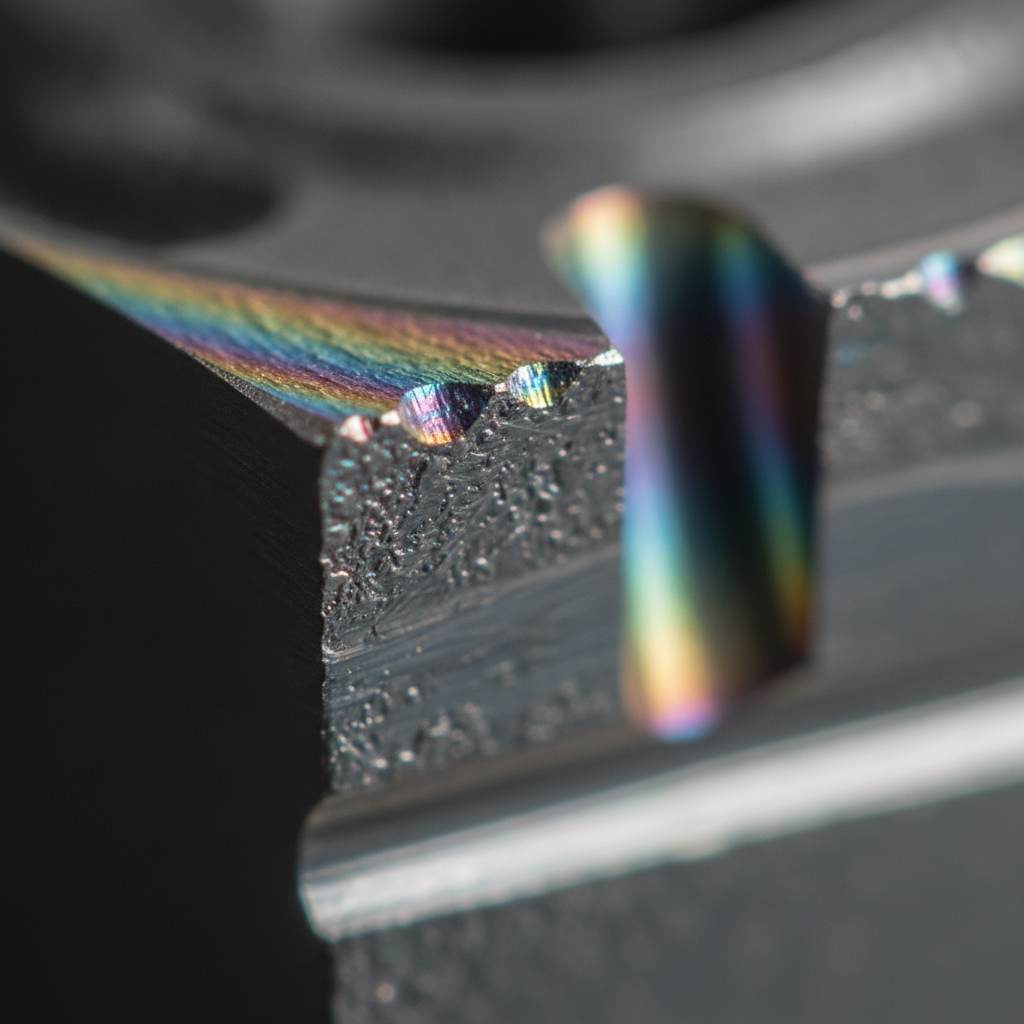
Physical Vapor Deposition Types Explained
The major physical vapor deposition types include magnetron sputtering, cathodic arc, thermal or e-beam evaporation, ion plating, and hybrid systems. Each balances density, stress, roughness, and rate differently. Choose sputter for smoothness control, arc for ion energy and adhesion, evaporation for lower heat input, and hybrids for tailored stacks.
Below is a high-level comparison you can use in design reviews. It’s a practical way to align process physics with part geometry, heat limits, and surface finish goals.
| PVD Type | Film Density | Surface Roughness | Deposition Rate | Thermal Load | Typical Use Cases |
|---|---|---|---|---|---|
| Magnetron Sputtering | High, compact | Low to medium (smooth control) | Moderate | Moderate | Precision edges, molds, optical or smooth-finish needs |
| Cathodic Arc | Very high, energetic ions | Higher (filtered arc reduces droplets) | High | Moderate to high | Adhesion-critical tools, hard base layers, heavy-wear dies |
| Thermal/E-beam Evaporation | Medium to high (depends on ion assist) | Low (very smooth, line-of-sight) | High | Low to moderate (good for temperature-sensitive parts) | Decorative, diffusion barriers, optical stacks, some molds |
| Ion Plating | High (ion-assisted growth) | Low to medium | Moderate | Moderate | Adhesion enhancement layers, complex geometries |
| Hybrid (Arc + Sputter) | Very high, tailored | Medium (engineered) | High | Moderate to high | Multilayer stacks balancing toughness and smoothness |
Want a deeper dive by use case? See our internal primer on PVD types and finishes and our DLC coating guide for low-friction applications.
Matching PVD Types to Your Application
Select a PVD type by aligning film structure to failure modes: wear, adhesion, heat, or corrosion. Sputter favors smoothness and tight tolerances; arc favors robust adhesion; evaporation limits heat input; hybrids build graded stacks. Always consider base material hardness, geometry, and production temperature profile.
Stamping and forming dies
- Challenge: Adhesive wear and galling on high-strength steels and aluminum.
- Fit: Arc-based nitrides or hybrid arc+sputter stacks for toughness and adhesion; polished top layers to control Ra.
- Result: More stable blanks per edge prep; lower lubricant dependency on sticky alloys.
Cutting tools (carbide and HSS)
- Challenge: Edge chipping and crater wear at high SFM/MRR.
- Fit: Multilayer sputtered nitrides/carbides for smoothness and heat management; DLC for nonferrous finishing.
- Result: Fewer tool changes per shift and tighter dimensional control across lot runs.
Plastic injection molds and hot runners
- Challenge: Sticking, vent burn, and wear in glass-filled resins.
- Fit: Sputtered or ion-plated stacks targeting low Ra and lubricity; DLC variants for demolding and abrasion.
- Result: Cleaner parting lines, faster release, and fewer manual interventions.
Aluminum die cast and extrusion tooling
- Challenge: Soldering and thermal fatigue at elevated temperature.
- Fit: Arc-hardened underlayers plus sputtered topcoats engineered for thermal cycling and oxidation resistance.
- Result: Extended die intervals and more predictable surface finish on extrudate.
For regulated sectors (nuclear, medical, aerospace), we align stacks with your drawing callouts and traceability, then document the recipe to lock in repeatability batch-to-batch.
Best Practices to Get Consistent PVD Results
Consistency comes from upstream prep, fixture strategy, and measurable QC. Define incoming cleanliness, geometry protection via masking, and finish targets. Standardize fixtures to control angle-of-incidence. Verify thickness, adhesion, Ra, and color on every lot. Keep recipes and fixtures fixed between runs for steady Cp/Cpk.
Preparation and masking
- Specify degreasing, ultrasonic cleaning, and microblasting sequences with acceptance criteria.
- Call out critical tolerances and sealing surfaces; use high-temperature masks and custom fixtures.
Fixture control
- Balance rotation and shadowing; duplicate Fixturing Bills of Material for repeat jobs.
- Document load maps with part orientation to replicate plasma exposure next time.
QC parameters that matter
- Thickness: Target 1–5 μm unless edge geometry demands thinner.
- Adhesion: Verify via standardized scratch/indent tests and witness coupons.
- Surface roughness: Measure Ra/Rz pre- and post-coating; lap if sealing surfaces require.
- Color/appearance: Use colorimetric patches to monitor process drift on nitrides.
Process discipline is the fastest path to coatings that behave the same way every run, even as product volumes grow.
The Sputtek Difference: Capacity, Certification, and Systems
Sputtek combines Canada’s largest PVD/DLC service footprint with ISO 9001:2015 and Nuclear N299.3 approvals. Our SPUN 2,000 and SPUN 4,000 systems support up to multi‑thousand‑kilogram loads per cycle, enabling prototype-to-volume scaling with consistent adhesion, microstructure, and documentation in a single Woodbridge facility.
We support the full lifecycle: in-house sandblasting, microblasting, degreasing, cleaning, stripping, polishing, lapping, and QC lab testing. This end-to-end control keeps lot-to-lot behavior tight and simplifies vendor management for your team.
- Engineering-led: In-house R&D and process innovation tuned to your materials and wear modes.
- Multiple PVD lines: Flexible scheduling for urgent maintenance pulls and campaign runs.
- Thermospray/Pulsed HVOF: Broader toolbox when thickness or thermal barrier properties are needed.

Tools and Resources for Selecting a PVD Route
Use a structured checklist: define failure modes, base material and hardness, geometry and Ra targets, operating temperature, lubricant/chemistry exposure, and cycle-time goals. Then shortlist PVD types that match physics to constraints. Lock in fixtures and QC metrics before the pilot run, and keep recipes frozen across production.
Internal selection checklist
- Failure modes: abrasion, adhesion, thermal, or corrosion dominated?
- Substrate: tool steel, carbide, stainless, or nonferrous alloy?
- Geometry: sharp edges vs. sealing surfaces; allowable post-lap?
- Process heat: expected steady-state and peaks by station?
- Chemistry: coolants, release agents, cleaning solvents?
- Documentation: PPAP, IQ/OQ/PQ, or plant-specific SOPs?
You can also benchmark cross-industry perspectives on coating durability. For example, protective coating practices in heavy infrastructure highlight how surface prep and environment control drive service life; see these broad coating guidance examples and durability discussions from outside precision tooling. The principle holds: preparation and process discipline determine coating outcomes.
Case Studies and Practical Examples
Real gains come from matching physics to failure modes and locking process variables. In stamping, machining, molding, and die casting, we document baseline metrics, pilot the coating, then fix fixtures and recipes. The result: repeatable intervals between interventions and steadier quality across shifts.
Automotive stamping — AHSS draw die
- Baseline pain: Galling and drag lines on advanced high-strength steel (AHSS) blanks after short runs.
- Action: Hybrid arc+sputter nitride stack with polished top; controlled Ra and edge prep.
- Outcome: Significantly longer intervals before touch-up; more uniform blanks per coil.
Carbide end mills — aluminum finishing
- Baseline pain: Built-up edge and chip welding on aluminum alloys.
- Action: DLC variant tuned for low friction and clean chip evacuation; thin film to maintain edge sharpness.
- Outcome: Smoother finishes and fewer tool changes per batch, with steadier spindle load traces.
Medical mold inserts — glass-filled resin
- Baseline pain: Sticking and abrasion in filled PEEK-like materials; frequent manual assists.
- Action: Sputtered stack for low Ra plus DLC top to reduce adhesion; documented cleaning regimen.
- Outcome: Faster release and cleaner parting lines; reduced unplanned stoppages.
Die casting core pins — thermal fatigue
- Baseline pain: Soldering and crack initiation from thermal cycling.
- Action: Arc-hardened underlayer with sputtered topcoat; fixture orientation to manage heat exposure.
- Outcome: Longer pin life and more predictable casting surface quality between rebuilds.
These examples match our core industries—automotive, aerospace, oil & gas, nuclear, medical, pharma, and food & packaging—where uptime and certification matter as much as pure coating physics.
How to Qualify a PVD Coating in Your Plant
Formalize trials like any process change: define success metrics, run controlled pilots, and lock variables. Track thickness, adhesion, Ra, and cycle time; compare against a clean baseline. Approve fixtures and recipes, then integrate the coating spec and lot documentation into your quality system.
- Define metrics: Intervals between interventions, scrap rate, Ra/finish targets, and witness coupon results.
- Run a pilot: Small batch on production parts; keep all upstream variables identical to baseline runs.
- Analyze: Compare cycle-time stability, finish, and tool condition over the same number of parts.
- Approve: Freeze fixtures, orientation, and recipe; document acceptance bands.
- Roll out: Migrate to scheduled campaigns with identical load maps and QC checklists.
For plants under PPAP or IQ/OQ/PQ regimes, we’ll align documentation and keep coating runs auditable end-to-end.
When to Consider DLC Within the PVD Family
Diamond-like carbon (DLC) coatings are PVD/CVD carbon films engineered for very low friction and high wear resistance. Use DLC where adhesive wear or chip welding dominates, or where clean release is mission-critical. Verify heat exposure and contact chemistry, then target the DLC variant that matches your environment.
- Nonferrous machining: suppress built-up edge and maintain sharpness.
- Molding: promote release on textured or polished surfaces.
- Mechanisms: reduce stick-slip in dry or boundary lubricated contacts.
For a deeper overview, explore our complete DLC guide and align the variant with your temperature and chemistry window.
Common Pitfalls and How to Avoid Them
Most coating “failures” trace back to variable prep, shadowed fixtures, or changing upstream conditions. Fix cleanliness, freeze fixtures, and standardize recipes. Validate adhesion with witness coupons every lot. Keep tool geometry and finishing consistent—coatings can’t mask burrs, tears, or heat checks.
- Inconsistent cleaning: lock process steps and acceptance tests.
- Shadowing: redesign fixtures to improve line-of-sight and rotation exposure.
- Geometry changes: document edge prep and polish steps; revalidate after changes.
- Heat excursions: monitor actual process temperatures across the cycle.
Here’s the thing—discipline upstream buys you the biggest downstream gains. The physics is sound; control is the differentiator.
Plan a Pilot with Sputtek
A well-structured pilot proves coating value on your parts, in your process. We’ll align fixtures and QC, run a controlled batch, and document results you can scale. From our Woodbridge facility, we support quick turns and certified documentation for regulated sectors.
Looking to stabilize uptime? Let’s align a pilot on your highest-variance tool or mold insert. You’ll get clear before/after data and a locked recipe for scale-up.
Connect with Sputtek to start a discovery call.
About PVD Systems: SPUN 2,000 and SPUN 4,000
Sputtek designs and runs high-capacity SPUN PVD systems. SPUN 2,000 suits multi-rack production with excellent uniformity; SPUN 4,000 scales to very large loads, keeping adhesion and microstructure consistent. Both support hybrid processes, robust bias control, and repeatable fixturing for steady lot behavior.
- Uniformity and rotation schemes designed for dense, even films on complex racks.
- Hybrid capability to combine arc adhesion layers with smooth sputtered topcoats.
- Recipe control and documentation integrated with lot traceability for audits.
For OEMs building in-house capability, we also engineer custom PVD coating system designs to your throughput and part geometry profile.
Frequently Asked Questions
Engineers often ask about temperature limits, thickness, and whether PVD changes dimensions. These answers summarize the most common points. For program-specific requirements, we align tests and documentation to your quality system and OEM standards.
Does PVD change part dimensions?
PVD adds a thin film, typically 1–5 μm, so dimensional impact is small. For sharp cutting edges or tight clearances, we may target thinner films and apply post-lapping on sealing or optical surfaces to hold Ra and fit.
Which physical vapor deposition types handle high heat best?
Arc-based and hybrid nitride stacks generally retain hardness at elevated temperatures and bond robustly to tool steels. Your actual limit depends on alloy, geometry, and duty cycle. We align the stack with your measured thermal profile.
Can DLC replace lubricants?
DLC reduces friction and can lower lubricant demand, but it isn’t a universal replacement. We evaluate contact pressure, temperature, and chemistry to determine whether a DLC variant can operate reliably in boundary or dry conditions for your application.
How do you verify adhesion?
We combine standardized adhesion tests, witness coupons, and inspection of high-stress features after pilot runs. Consistent cleaning, ion activation, and a suitable bond layer are the primary levers for adhesion on production parts.
Key Takeaways
Match PVD physics to failure modes, freeze fixtures and recipes, and document QC. That combination delivers longer intervals between interventions and steadier quality. Local access to Sputtek’s certified lines in Woodbridge shortens cycles, keeps audits clean, and supports scale-up without surprises.
- Choose the PVD type by heat, geometry, and wear mode—not by brand name.
- Control prep, fixtures, and recipes; then measure thickness, adhesion, and Ra every lot.
- Pilot first, document success, and keep variables frozen as you scale.
Where to Learn More
Deepen your understanding of physical vapor deposition types and low-friction variants, then align a pilot on your highest-variance tool. Internal primers and cross-industry coating discussions help frame trade-offs before you commit to fixtures and recipes.
Review our internal overview of PVD deposition types and the DLC primer. For broader coating discipline concepts outside precision tooling, see this coating guide example and this short note on extending service life.