
A Practical Guide to Industrial Coating
Industrial coating is the engineered application of thin films or thick protective layers to parts and tools to enhance performance, longevity, appearance, or cleanliness. Whether the goal is to improve wear resistance, reduce friction, mitigate corrosion, or maintain sanitary surfaces, the right coating and process pairing can make a measurable difference in uptime and part life. This guide provides a practical framework to understand common coating technologies, how to qualify a solution, and what to watch during preparation, application, and validation.
What is industrial coating?
Industrial coating encompasses a broad set of processes that deposit or form functional layers on a substrate. These layers may be a few nanometers to several millimeters thick and are tailored to the operating environment. Typical goals include:
- Wear resistance: protecting surfaces from abrasion, erosion, galling, and fretting.
- Friction control: lowering or tuning the coefficient of friction for smoother motion, reduced heat, or easier release.
- Corrosion protection: adding chemical barriers against oxidation, moisture, or aggressive media.
- Thermal management: providing thermal barriers or emissive surfaces.
- Cleanability and hygiene: improving surface smoothness or inertness where cleanliness is critical.
Because no single coating solves every challenge, understanding operating conditions and matching them to a process is essential.
Common processes and where they fit
Many technologies fall under industrial coating. Below is a concise, practical view of widely used methods and the problems they are designed to address. Always validate with small trials before large-scale adoption.
PVD (Physical Vapor Deposition)
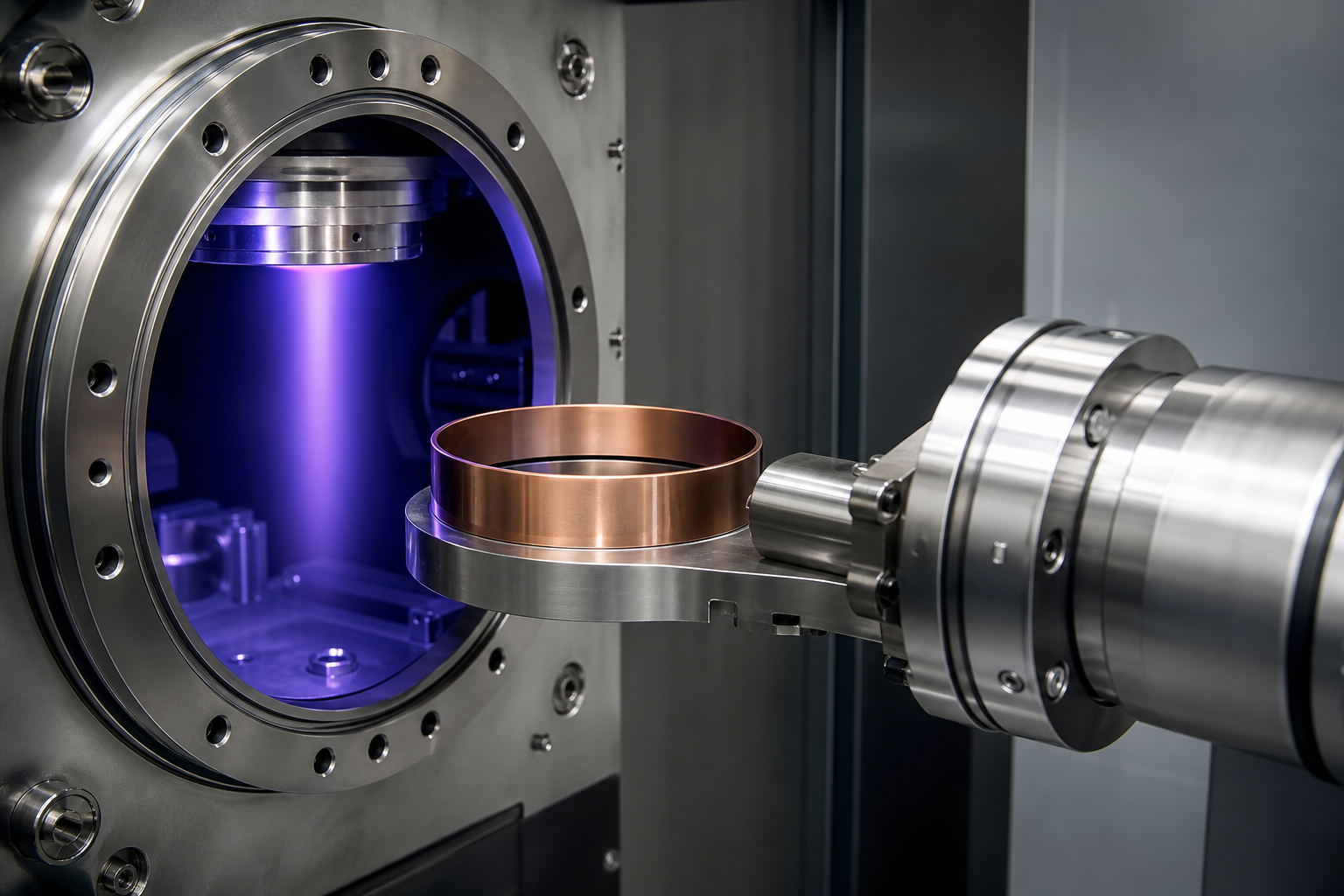
PVD forms dense, well-adhered thin films in vacuum by vaporizing source materials and depositing them on the substrate. It is commonly used on tools and components where hardness, wear resistance, and tailored friction are needed. Films can include nitrides, carbides, oxides, and diamond-like carbon (DLC) types to tune properties such as hardness, lubricity, and color.
Diamond-Like Carbon (DLC)
DLC is a class of carbon-based coatings with high hardness and low friction characteristics. It is frequently selected for sliding or forming applications where reduced adhesion and smoother motion are desirable. DLC may be applied by PVD-related processes among others.
Thermal Spray and Pulsed HVOF
Thermal spray processes project molten or semi-molten particles onto a prepared surface to build thicker, protective layers. High Velocity Oxy-Fuel (HVOF), including pulsed variants, produces dense, strongly bonded coatings suitable for wear and corrosion service, dimensional restoration, or thermal barriers depending on the feedstock.
Other categories at a glance
- Electro- and electroless plating: metallic layers for corrosion resistance, solderability, and wear.
- Conversion coatings and anodizing: surface transformations that improve corrosion resistance or paint adhesion.
- Organic paints and powder coats: barrier protection, color, and environmental resistance for enclosures and structures.
- Chemical and sol-gel thin films: functional or barrier layers on metals, glass, and ceramics.
Material selection and design considerations
Selecting a coating starts with quantifying your environment and performance goals. Use the following input checklist to accelerate scoping and avoid rework.
Operating environment checklist
- Temperature window (continuous and peak, ramp rates, thermal cycling).
- Mechanical loads (contact pressure, Hertzian stress, impact, vibration).
- Motion and friction regime (sliding, rolling, oscillating; dry, boundary, mixed, hydrodynamic).
- Media exposure (humidity, salt, cleaning agents, fuels, coolants, food, pharmaceuticals).
- Part geometry and tolerances (thin features, blind holes, sharp edges, masking needs).
- Electrical and magnetic constraints (conductivity, insulation, RF behavior).
- Aesthetic and identification needs (color, gloss, traceability marks).
Substrate and adhesion
Coating performance is inseparable from the substrate. Consider hardness, microstructure, prior heat treatments, and residual stresses. Many thin-film systems rely on diffusion or graded adhesion layers to bridge property differences. Confirm that any pre-treatment (e.g., blasting, etching) is compatible with base material and downstream requirements.
Thickness and tolerances
Coating thickness affects clearances, edge buildup, and stress. For precision tools, micrometer-scale control may be necessary; for restoration or barrier layers, tens to hundreds of micrometers (or more) may be appropriate. Specify nominal thickness, allowable range, and critical surfaces to be measured, then align on metrology methods (e.g., calo test, XRF for composition, cross-section microscopy).
Surface preparation and application basics
Preparation typically accounts for much of coating success. The following steps outline a robust, vendor-agnostic baseline.
- Define the finish: Identify which faces are functional, which are cosmetic, and where masking is required.
- Clean to bare substrate: Remove oils, oxides, and contaminants by degreasing, ultrasonic cleaning, and controlled drying.
- Texture tuning: Use grit size and blasting parameters to reach the target roughness that balances mechanical interlocking with finish needs.
- Dimensional checks: Confirm critical features pre-coating to prevent tolerance stack-up surprises.
- Fixture planning: Optimize orientation, line-of-sight, and thermal mass to promote uniform deposition and reduce shadowing.
- Process definition: Lock in process variables—temperature, time, pressure/flow, energy input, and feedstock or target material.
- Lot traceability: Assign batch IDs and capture equipment and material lots for root-cause analysis if issues arise.
For PVD and related thin films, cleanliness and vacuum compatibility are critical; for thermal spray, anchor profile and bond coats may be decisive. In all cases, consistent fixturing and repeatable handling reduce variation.
Quality control, measurement, and testing
Verification ensures the coating you specified is the coating you received. Build a quality plan with measurable checkpoints:
- Incoming inspection: Verify substrate material certificates and pre-process dimensions.
- Process monitoring: Record key parameters and maintain calibration for sensors, gas flows, and temperature probes.
- Thickness and uniformity: Use agreed methods and sampling plans; document statistics, not just single values.
- Adhesion: Apply suitable tests (e.g., scratch, pull-off, bend) aligned to thickness and application.
- Hardness and roughness: Confirm post-process surface state supports the intended function.
- Friction behavior: Where relevant, measure coefficient of friction under representative loads and lubricants.
- Corrosion exposure: Run standardized spray or immersion tests only where applicable to your environment.
- Functional trials: Conduct pilot runs in production-like conditions before full rollout.
Retain test coupons or witness samples from each lot where practical. This adds confidence and provides a reference if parts are reworked or refurbished.
Application examples by use case
The following generalized pairings illustrate how to translate requirements into candidate approaches. Treat them as starting points for trials.
- Stamping and forming tools: Thin, hard films to reduce adhesion buildup and wear at edges and radii.
- Cutting and machining tools: High-hardness, heat-tolerant coatings to maintain sharpness and chip flow.
- Plastic processing molds and components: Low-friction, inert surfaces that promote release and resist abrasion.
- Aluminum die cast and extrusion tooling: Coatings tuned for thermal shock resistance, soldering mitigation, and erosion control.
- General components: Wear and corrosion overlays or thin films depending on duty cycle and dimensional limits.
Decision framework: selecting a solution
Use this step-by-step framework to converge on a coating with reduced guesswork.
- Define the failure mode: Is it adhesive wear, abrasive wear, corrosion pitting, thermal cracking, or frictional heat?
- Quantify the envelope: Temperature, load, speed, media, and cycles to failure.
- Screen processes: Shortlist two to three technologies whose capabilities span your envelope.
- Plan A/B trials: Test at least two candidates on controlled coupons and representative parts.
- Measure the right metrics: Prioritize those tied to cost-of-failure (e.g., edge retention, release force, time-to-failure).
- Scale deliberately: Move from pilot to limited production while monitoring variation and downstream impacts.
- Document and lock: Freeze the winning process window and fixturing; capture do-not-alter notes.
Maintenance, repair, and refurbishment
Coatings are part of a system. Their benefit depends on maintenance discipline and thoughtful end-of-life handling.
- Cleaning protocols: Use approved agents and non-abrasive methods to preserve surface properties.
- Inspection intervals: Track wear landmarks (edges, radii, contact bands) and correlate to operating hours.
- Rework criteria: Define thresholds for polishing, stripping, and recoat versus full replacement.
- Fixturing and handling: Protect edges and coated faces during storage and changeovers.
- Root-cause feedback: When failures occur, capture environment and load data to refine process windows.
Documentation and traceability essentials
Clear documentation reduces downtime and speeds corrective actions. At minimum, maintain:
- Part and drawing revision, with coated surfaces called out using consistent symbols and notes.
- Coating specification sheet: process family, material, thickness range, roughness targets, and test methods.
- Lot records: substrate material heats, pre-process dimensions, fixturing diagrams, and process parameters.
- Certificate of conformance content: actual measurements, sampling plan, and any deviations with approvals.
- Change control: documented approvals for adjustments in media, fixturing, or recipe parameters.
FAQ
How do I compare thin films like PVD to thicker overlays such as thermal spray?
Start with dimensional tolerance and failure mode. If you need micrometer-scale control, low friction, and high surface hardness without altering part geometry, thin films are strong candidates. If you require impact resistance, corrosion or erosion protection with measurable thickness, or dimensional restoration, thicker overlays are often more suitable.
What information should I include when requesting a coating quote or DFM review?
Provide the substrate alloy, heat treatment, hardness, operating temperature range, contact loads, motion type, media exposure, target lifetime or cycles, critical surfaces, masking needs, and acceptable thickness range. Adding photos of the part, fixturing constraints, and any previous failure data helps accelerate a practical recommendation.
Can a single coating optimize both wear resistance and very low friction?
Sometimes, but trade-offs are common. Coatings optimized for extreme hardness may not always provide the lowest friction under all lubricants or loads. Define which outcome is the primary driver, then screen candidates and surface finishes that balance both needs under your exact conditions.
How should I validate a new coating before production rollout?
Run small-lot trials on representative parts, measure thickness, adhesion, and surface state, then conduct functional tests under realistic conditions. Track key performance indicators tied to your cost of failure, and scale only after variation is understood and controlled.
When is recoat preferable to part replacement?
If the substrate remains dimensionally and structurally sound, and the cost and lead time of stripping, preparing, and recoating are competitive with new parts, recoat can be advantageous. Establish objective thresholds for wear, cracks, or distortion to guide that decision.