
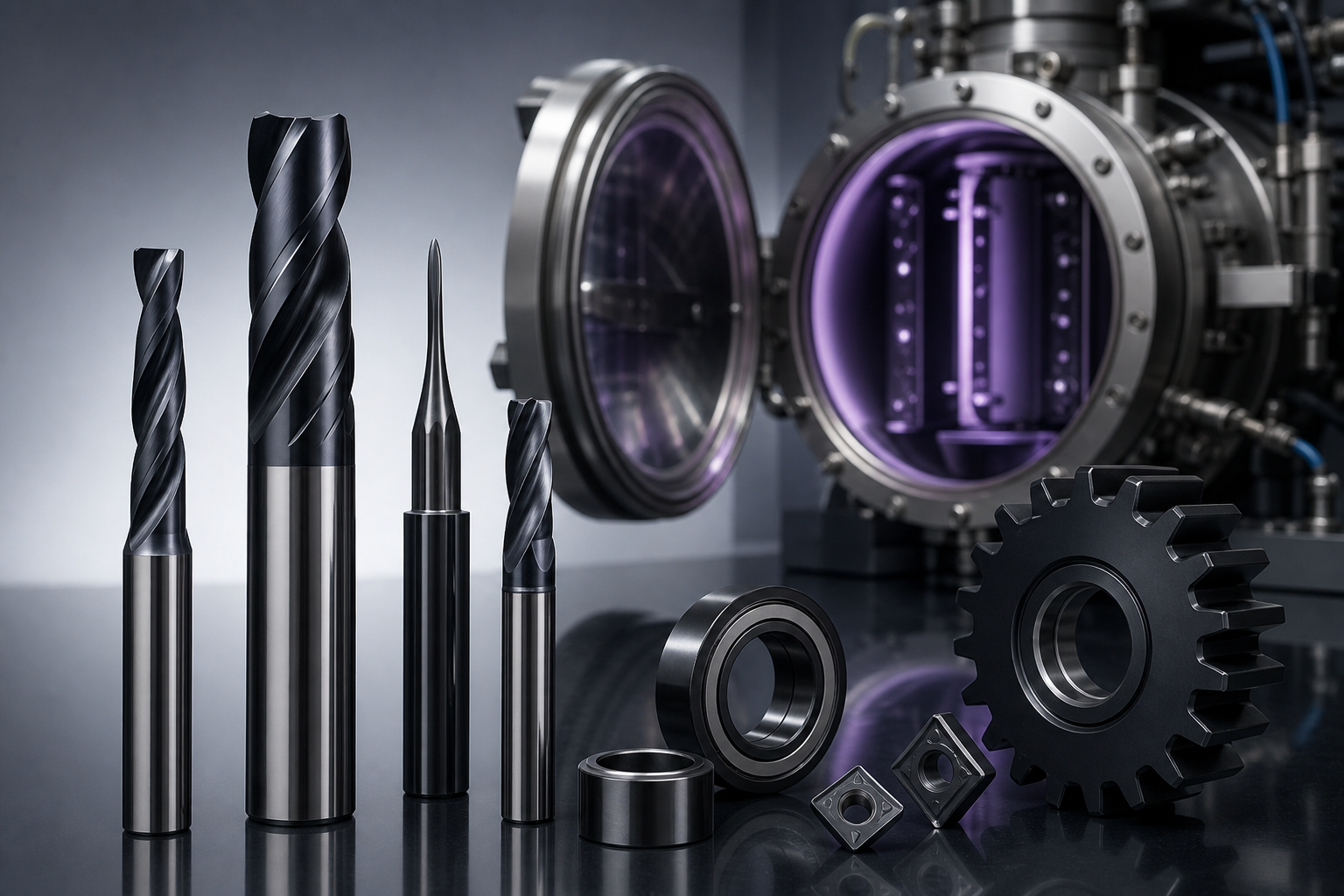
What are DLC coating applications and why do they matter?
Diamond-like carbon, or DLC, coating applications describe the parts and operating conditions where a thin, carbon-based film reduces friction, resists abrasion, and improves chemical inertness to extend component life. Engineers specify DLC where low friction and high surface hardness change a component’s failure mode from surface wear to base-material endurance. This article defines DLC, illustrates the highest-value industrial and medical uses, compares trade-offs with common alternatives, and provides a practical vendor checklist for procurement and qualification.
Definition: what DLC coatings are and their core properties
DLC refers to a family of amorphous carbon films that combine sp2 and sp3 bonding to produce a coating with high hardness, low coefficient of friction, chemical inertness, and good tribological performance. Deposition methods vary, and some DLC films are applied by physical vapor deposition or ion beam processes. The combination of abrasion resistance and low friction makes DLC suitable for abrasion-sensitive and sliding contact parts. Commercial applications have historically included protective optics and precision moving components, see the commercial applications of ion beam deposited DLC for background (ScienceDirect). For a practical specification checklist, consult the Complete DLC Coating Guide from Sputtek (Sputtek).
Top DLC coating applications by industry
DLC coating applications appear where sliding contact, adhesive wear, or chemical exposure limit part life. Below are common industry examples with typical part types and the performance objectives DLC helps achieve.
Automotive: moving parts, seals, and fuel-system components
In automotive systems DLC is often specified for reciprocating and rotating components where friction reduction and wear resistance improve efficiency and lifetime. Typical parts include fuel injector nozzles and pintles, piston rings and wrist pins, transmission synchromesh components, valve train pins, and sensor sliding elements. The objective is to reduce frictional losses, limit adhesive transfer or galling, and maintain tight clearances under repeated motion.
Aerospace: bearings, actuators, and sliding surfaces
Aerospace applications exploit DLC’s low friction and wear resistance on flight control bearings, hydraulic actuator rods, and sliding seals. Where safety margins and certification demand traceable processes and documented testing, DLC is used to reduce stick-slip, lower required lubrication, or protect mating surfaces in low-lubrication scenarios.
Medical and biomedical: implants and instruments
DLC coating applications in medical devices include blood-contacting and mechanically stressed components such as stents, surgical instruments, and articulating implant interfaces. Recent reviews highlight DLC’s potential to reduce wear and to lower restenosis risk for certain cardiovascular device designs, while noting that biocompatibility and device-specific testing are required before clinical use. See the review on DLC in biomedical applications for detailed context (ScienceDirect). Plan regulatory and biological testing early in procurement.
Tooling, cutting, and forming dies
Cutting tools, stamping dies, and injection mold cores benefit from DLC when the failure mode is adhesive wear, polymer sticking, or galling. DLC reduces material transfer and tackiness that produce burrs, scoring, and tool heating, which improves part quality and reduces downtime for tool maintenance.
Optics, electronics, and precision components
Where surface protection must not compromise optical properties or tight tolerances, DLC serves as an abrasion-resistant, chemically inert protective film on lenses, protective windows, and small sliding microcomponents. Some ion beam deposited DLC variants are used on optics for their transparency and chemical stability in harsh environments.
Oil and gas and heavy industry: combined wear and corrosion
DLC coating applications extend to valves, pump shafts, downhole components, and moving seals where wear and corrosive media act together. In some heavy industry cases, thermospray or pulsed HVOF alternatives are considered when impact and thick-coating corrosion protection are dominant, but DLC is chosen where sliding wear with low friction is the primary concern.
Material compatibility and design considerations
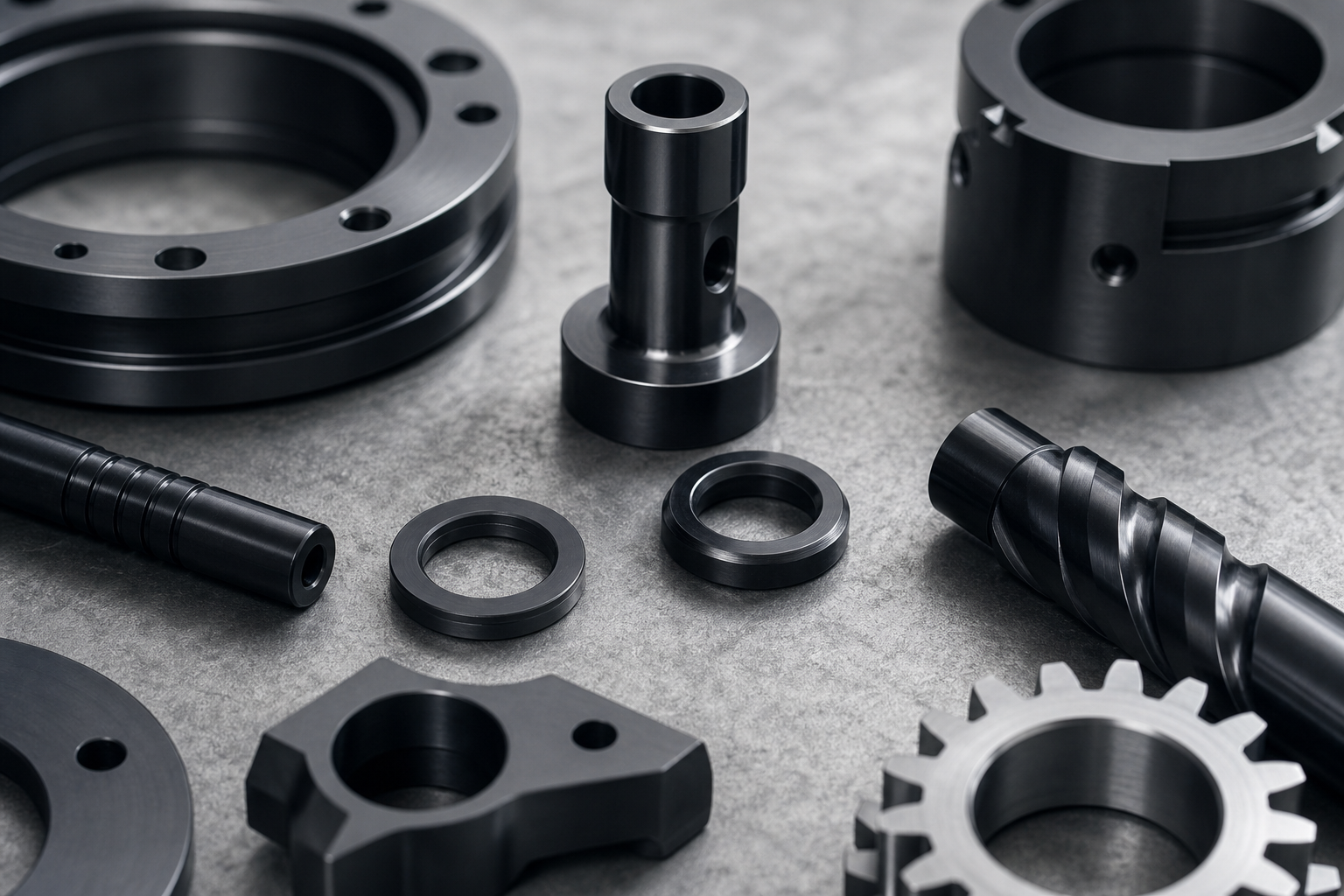
Engineers must consider substrate metallurgy, part geometry, and surface preparation when specifying DLC. Common substrate families include steels and titanium. Aluminium can be coated but often requires an interlayer or careful surface activation to maintain adhesion. Thin walls, sharp edges, and internal features complicate uniform coverage and may necessitate specialized fixturing or process adaptation. Decision points include whether an interlayer is required for adhesion, the target coating thickness relative to tolerances, and final surface roughness requirements, each of which affects tribological performance and must be validated by testing. For a sample acceptance test plan, see the Complete DLC Coating Guide from Sputtek (Sputtek).
Performance trade-offs: when to choose DLC versus other coatings
DLC excels at low friction and high surface hardness, but trade-offs exist. Compared with hard PVD nitrides, DLC often offers lower friction but may be less tolerant of high tensile contact stresses or sharp impact. Chromium plating provides excellent corrosion resistance and hardness at thicker layers, but it does not match DLC’s low friction in sliding contacts. Thermal spray and pulsed HVOF coatings supply thick, impact-resistant layers suited to heavy wear and corrosion, but they deliver higher surface roughness and do not match DLC for low friction in precision sliding contacts. Choose DLC when sliding friction reduction and surface hardness are primary, and consider alternatives when impact resistance, very high abrasion volume, or thick corrosion barriers are required. Sputtek’s service portfolio includes both DLC and thermospray options to support case-by-case assessment (Sputtek).
Tests and specifications engineers should request
Quality validation for DLC coating applications relies on a set of mechanical and corrosion tests. Buyers should request a clear test plan covering adhesion, tribology, thickness, roughness, and corrosion screening. Below are common items and what they reveal.
- Tribology tests: pin-on-disk or reciprocating wear tests show friction trends and qualitative wear behaviour under defined loads and speeds.
- Adhesion tests: progressive scratch testing and Rockwell-type indentation reveal whether the coating will delaminate under load.
- Thickness and roughness: nondestructive thickness measurements and profilometry for Ra ensure the coating meets dimensional and surface finish requirements for mating parts.
- Corrosion screening: basic salt spray or relevant chemical exposure checks identify whether the coating and any interlayers protect the substrate for the intended environment.
- Biocompatibility and device testing: for medical applications, literature supports DLC benefits but device-level biological and mechanical testing must be specified and executed in accordance with regulatory requirements.
Real procurement objections and practical responses

Procurement often raises concerns about cost, lead time, minimum order quantities, and part risk. Reasoned responses include requesting a prototype sample run to quantify performance improvement before committing to volume production, asking for a written test plan and traceability matrix, and confirming in-house pre and post capabilities so the vendor controls blasting, cleaning, stripping, and lapping to reduce handling risk. If distortion of thin parts is a concern, discuss fixturing and thermal exposure limits with the vendor early in the quotation stage.
Vendor selection checklist and local sourcing in Canada
When sourcing DLC coating services, use a concise checklist to compare vendors. Key items are listed below with why each matters.
- Quality system certification, for example ISO 9001:2015, documents consistent processes and traceability, which is essential for regulated sectors. Sputtek lists ISO 9001:2015 among its credentials on its website (Sputtek).
- Regulatory approvals where required, such as nuclear vendor qualification or medical device manufacturing experience, are important when OEMs or regulators require supplier qualification. Sputtek notes Nuclear N299.3 approval on its site.
- In-house preparation and post-processing like sandblasting, microblasting, degreasing, stripping, polishing, and lapping reduce logistical variability and speed qualification cycles.
- Testing and QC lab on-site helps shorten feedback loops during development and supports traceable acceptance testing.
- Production scale capability confirms cycle capacity and batch handling if you plan to move to high-volume production, and larger PVD systems enable consistent batch processing.
- Engineering support and sample runs demonstrate process control and help with fixture design and material compatibility validation.
As an example of these capabilities in Canada, Sputtek operates a modern Greater Toronto Area facility with end-to-end in-house preparation and coating services and provides both PVD/DLC and thermospray options for parts qualification and volume work. For more detailed selection and specification guidance, consult the Complete DLC Coating Guide (Sputtek).
Practical next steps: how to evaluate parts for DLC and request a quote
To move a part toward qualification for DLC coating applications, use this short checklist:
- Collect part drawings, base-material specification, and critical dimensions or tolerances.
- Document the operating environment: loads, sliding speed, temperatures, lubrication, and any chemical exposure.
- Specify target performance goals: lower friction, reduced wear, surface protection, or biocompatibility.
- Request a vendor sample run with defined test methods: pin-on-disk or reciprocating wear, scratch adhesion, thickness and roughness, and a corrosion screen where applicable.
- Ask for traceability, handling procedures, and an agreed plan for moving from prototype to volume if tests meet requirements.
When you are ready to request a parts evaluation, include the checklist and ask vendors to propose an acceptance test matrix and a sample timeline for qualification.
FAQ
Is DLC suitable for aluminium parts and what extra steps are required
DLC can be applied to aluminium substrates, but aluminium often needs an intermediate layer or specialized surface activation to ensure durable adhesion. Discuss interlayer options and qualification testing with your vendor and include adhesion and thermal stability checks in the acceptance plan.
Can DLC coatings be used on medical implants and what regulatory checks are needed
DLC is used in biomedical applications and literature reports reductions in wear and specific clinical benefits for some devices, but device-level biocompatibility, mechanical fatigue, and regulatory testing are required before clinical deployment. Plan for device-specific biological and mechanical testing early in development.
How does DLC compare to PVD nitride coatings for cutting tools
DLC typically offers lower friction and good hardness, which helps with adhesive wear and polymer sticking. PVD nitrides often tolerate higher thermal loads and may resist abrasive wear differently. Choose based on the dominant wear mechanism, and validate with representative cutting tests.
What tests should a buyer require to validate a DLC coating before production
Request a combination of tribology testing (pin-on-disk or reciprocating wear), adhesion testing (scratch or indentation), nondestructive thickness and profilometry, and basic corrosion screening. For medical devices include biocompatibility tests relevant to the application.
What vendor certifications and in-house capabilities matter when sourcing DLC coating services in Canada
Look for ISO 9001:2015 certification and any industry-specific approvals you require, such as nuclear vendor qualification or medical device manufacturing experience. In-house preparation, post-processing, and a QC laboratory shorten qualification cycles and improve process control.
Ready to evaluate parts or discuss DLC coating applications for your program? Request a parts evaluation or detailed specification support from Sputtek.