
Choose Advanced PVD Coatings for Real Service Loads
“We need a harder coating” is not a complete specification. A tool may fail through adhesive wear, abrasion, edge chipping, plastic deformation, corrosion, thermal fatigue, lubricant breakdown or an interaction between several mechanisms. A coating selected from one impressive property can move the failure instead of solving it.
Sputtek’s current website presents PVD and thermospray services for tooling and components and identifies stamping, machining, die-casting, plastic moulding and component applications. Those pages establish capability context; they do not prove a coating will meet the requirements of a new part or that a claimed certification, turnaround or property applies to the requested job.

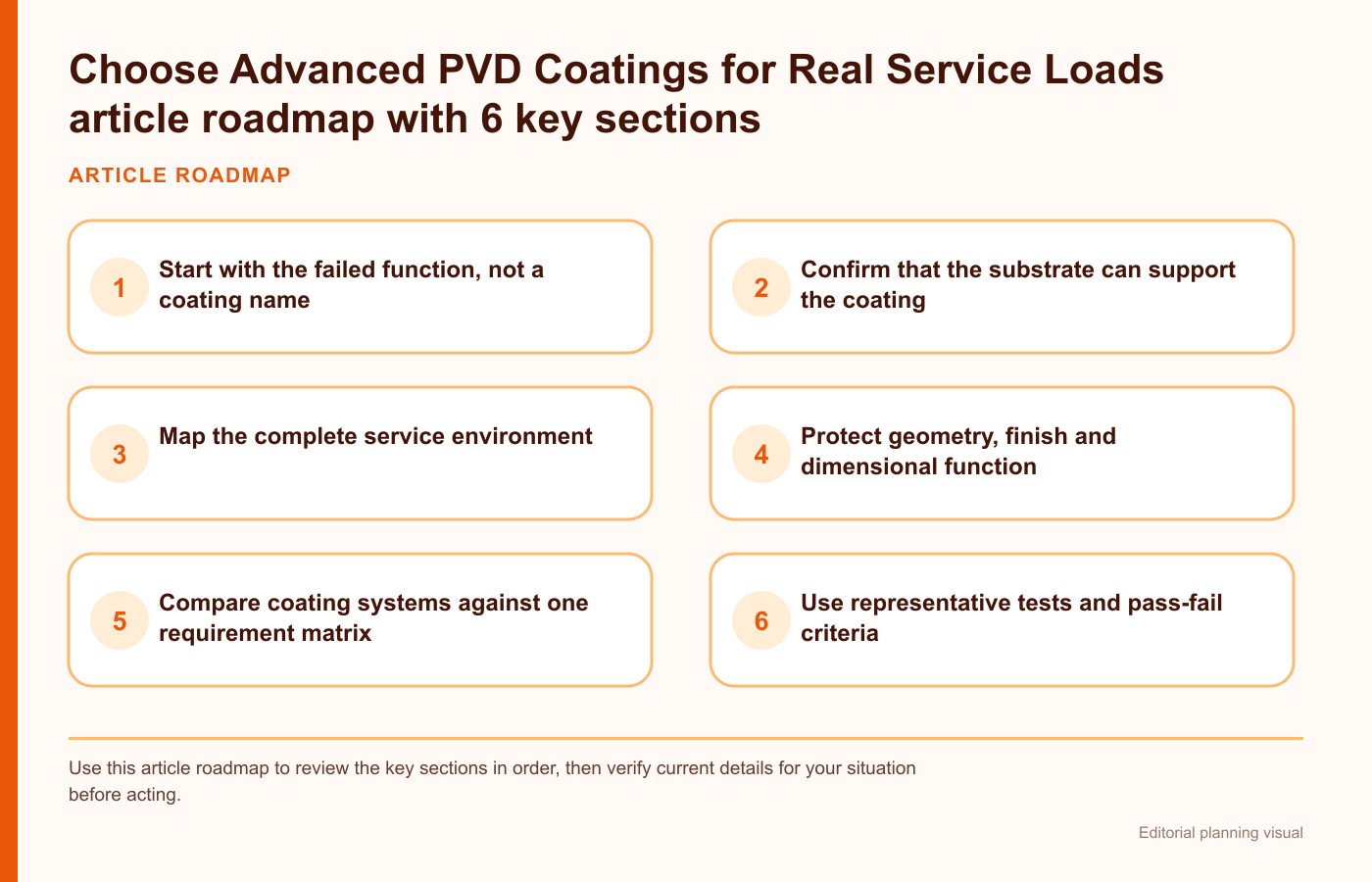
Start with the failed function, not a coating name
Collect failed parts and operating records before contacting suppliers. Describe where damage begins, how it develops and what ends the useful run. Include photographs, dimensional measurements, production counts, material transfer, lubricant condition and counterface changes. Separate gradual wear from sudden fracture or substrate deformation; a coating cannot compensate for an under-strength base material or unstable process.
| Observed symptom | Questions to investigate | Coating-selection implication |
|---|---|---|
| Galling or material pickup | Which surfaces contact, under what pressure, sliding speed and lubrication? | Evaluate tribology as a system, including counterface and lubricant |
| Abrasive wear | What particles, scale or fibres cross the surface? | Hardness alone is insufficient; toughness and support matter |
| Edge chipping | Is the substrate deflecting, impacting or carrying sharp geometry? | Review edge preparation, support and residual stress |
| Thermal checking | What are the surface temperature, cycle and cooling conditions? | Match coating and substrate to thermal cycling |
| Corrosion or staining | Which chemicals, humidity and cleaning agents are present? | Verify full-system compatibility and exposed edges |
If the root cause is uncertain, request failure analysis before requesting a production coating. A supplier application table is a starting point, not a diagnosis.
Confirm that the substrate can support the coating
Document the exact alloy, grade, heat treatment, hardness range, prior coatings, braze or weld history and surface condition. Ask whether the intended process temperature could temper, distort or otherwise change the part. Coating adhesion and load support depend on the substrate and interface, not only the deposited film.
NIST’s surface-engineering measurement guide describes scratch adhesion testing for standard PVD coatings and explicitly notes that results are highly dependent on the substrate. That means an adhesion number from a polished laboratory coupon cannot automatically predict performance on a sharp-edged, textured or differently hardened production part.
- Identify sensitive dimensions and datum surfaces.
- Mark areas that must be coated, masked or left uncoated.
- State whether stripping and recoating are allowed.
- Define permissible polishing, blasting or edge preparation.
- Provide cleanliness, corrosion and packaging expectations.
Map the complete service environment
Specify normal and worst-case load, contact pressure, speed, impact, temperature, cycle time and duty cycle. Name the work material, counterface, lubricant, coolant, cleaners and process chemicals. Include storage, sterilization, washdown and transport conditions when they matter. A PVD film may see a very different environment during cleaning or maintenance than during production.
Industry context changes the buying decision. A food-contact part may need material and cleaning evidence tied to the exact use. A medical-device manufacturer must manage biocompatibility, cleanliness, sterilization and regulatory evidence for the finished device. Health Canada’s recognized-standards list shows why raw material or generic coating data does not replace final-device risk and evidence.
Protect geometry, finish and dimensional function
Measure the incoming part and state the post-coating dimensional window. Thin films still matter at fits, cutting edges, vents, micro-features, threads and sealing surfaces. Line-of-sight and fixture orientation can affect coverage. Roughness, polishing and droplet or defect tolerance may be more important than nominal thickness for a sliding or optical surface.
Ask how parts are fixtured, which areas receive lower exposure, how masking lines are controlled and how witness coupons relate to real geometry. If the part must be stripped later, define the allowable base-material loss and number of cycles.
Compare coating systems against one requirement matrix
Sputtek’s PVD overview describes cathodic arc, pulsed cathodic arc, sputtering and hybrid process context. Its stamping and machining pages organize application examples. Use those routes to form questions, then request part-specific data rather than copying a coating from a neighbouring application.
| Selection field | Supplier response required |
|---|---|
| Coating system | Layer concept, deposition family and intended failure mechanism—not proprietary recipe |
| Compatibility | Substrate, heat treatment, process temperature and pre-treatment limits |
| Geometry | Fixture, masking, coverage and post-process finish plan |
| Properties | Test method, specimen, uncertainty and relevance to the application |
| Inspection | Lot records, witness samples, thickness or adhesion method and visual criteria |
| Change control | Which process, material, equipment or subcontractor changes require notice |
Use representative tests and pass-fail criteria
Choose tests based on the service mechanism. Scratch testing can support comparative PVD process control, but it does not reproduce every service load. ASTM C633 addresses tensile adhesion or cohesion of thermal-spray coatings and warns that its result should not be used as an intrinsic design value for a specific environmental stress. It is also not a thin-film PVD test. The correct method depends on the process and question.
A robust trial has a baseline, controlled candidate lots, representative parts and an agreed end point. Record substrate lot, heat treatment, surface preparation, coating batch, fixture position and post-processing. Evaluate more than one part and, where necessary, more than one production run. Do not declare success from a single visually good coupon.
- Define the baseline failure metric and measurement method.
- Choose representative parts, coupons and operating conditions.
- Predefine rejection conditions such as delamination, dimensional drift or unacceptable finish.
- Run a controlled production trial without changing several variables at once.
- Inspect the coating and the substrate after service.
- Decide whether the evidence supports release, another iteration or rejection.
Set production quality and traceability controls
ISO explains that ISO 9001 is a quality-management-system standard covering controlled processes, documented information, monitoring and improvement; it does not prescribe a coating or prove its performance. If certification is required, verify the certificate, issuing body, site, scope and current status. Then add project-specific controls.
The purchase specification should identify drawing revision, part condition, quantity, masking, pre-treatment, coating designation, permitted process window, inspection, sampling, records, packaging, nonconformance handling and change notification. Decide whether witness coupons travel with each lot and how long records are retained. For regulated products, the customer retains responsibility for its design and regulatory evidence.
Build a decision-ready coating RFQ
A useful request is a small engineering package, not “price for black PVD.” Include the problem statement, drawings, alloy and heat treatment, annual and batch quantities, sensitive surfaces, current failure evidence, service environment, cleaning, regulatory context, required tests and target decision date. State which information is confidential and establish an appropriate agreement before sharing proprietary designs.
- Which failure mode does the proposed system address?
- What substrate and surface condition does it require?
- What process temperature and dimensional change should be evaluated?
- How will coating consistency and critical properties be measured?
- What representative trial do you recommend and why?
- What result would cause you to reject or redesign the coating?
- Which certifications and approvals apply to this site and scope?
- What part, process or supplier changes trigger notification?
Red flags when buying advanced coatings
- A universal “best coating” is recommended without failed-part review.
- Property values have no test method, specimen or substrate.
- A coupon result is presented as guaranteed part life.
- The quote omits masking, preparation, stripping, polishing or inspection.
- Certification is claimed without current scope and certificate verification.
- Food, medical or nuclear suitability is asserted from composition alone.
- No trial, lot traceability or change-control process is defined.
- The supplier will not discuss failure conditions or nonconformance handling.
Frequently asked questions
Is the hardest PVD coating always the most wear resistant?
No. Wear depends on the mechanism, substrate support, toughness, adhesion, counterface, lubrication, roughness, temperature and geometry. Hardness is one input, not a universal ranking.
Can a coating repair an undersized or damaged tool?
Do not assume so. PVD is generally selected for surface function, not uncontrolled dimensional repair. Have the tool and substrate evaluated and define allowable preparation and final dimensions.
What test proves a PVD coating will work?
No single test proves every application. Use standardized measurements for controlled comparison and a representative service trial tied to a predefined failure metric.
Does ISO 9001 certification prove the coating meets my drawing?
No. It addresses a quality management system. The coating still needs a clear specification, process control, inspection, traceability and part-specific validation.
Bring the failure evidence to the supplier
The fastest productive conversation begins with the failed function, known substrate, service loads and measurable target. It may conclude that preparation, geometry, heat treatment, lubrication or base material must change before coating selection. That is a better engineering outcome than forcing a film onto an undefined problem.
Sources reviewed
- Sputtek website, PVD overview and application routes — first-party capability context only.
- NIST surface-engineering measurement guide — measurement selection and substrate-dependent PVD scratch testing.
- ASTM C633 — thermal-spray adhesion/cohesion test scope and interpretation limits.
- ISO 9001 explained — QMS scope and limitations.
- Health Canada recognized medical-device standards — regulated finished-device evidence context.