
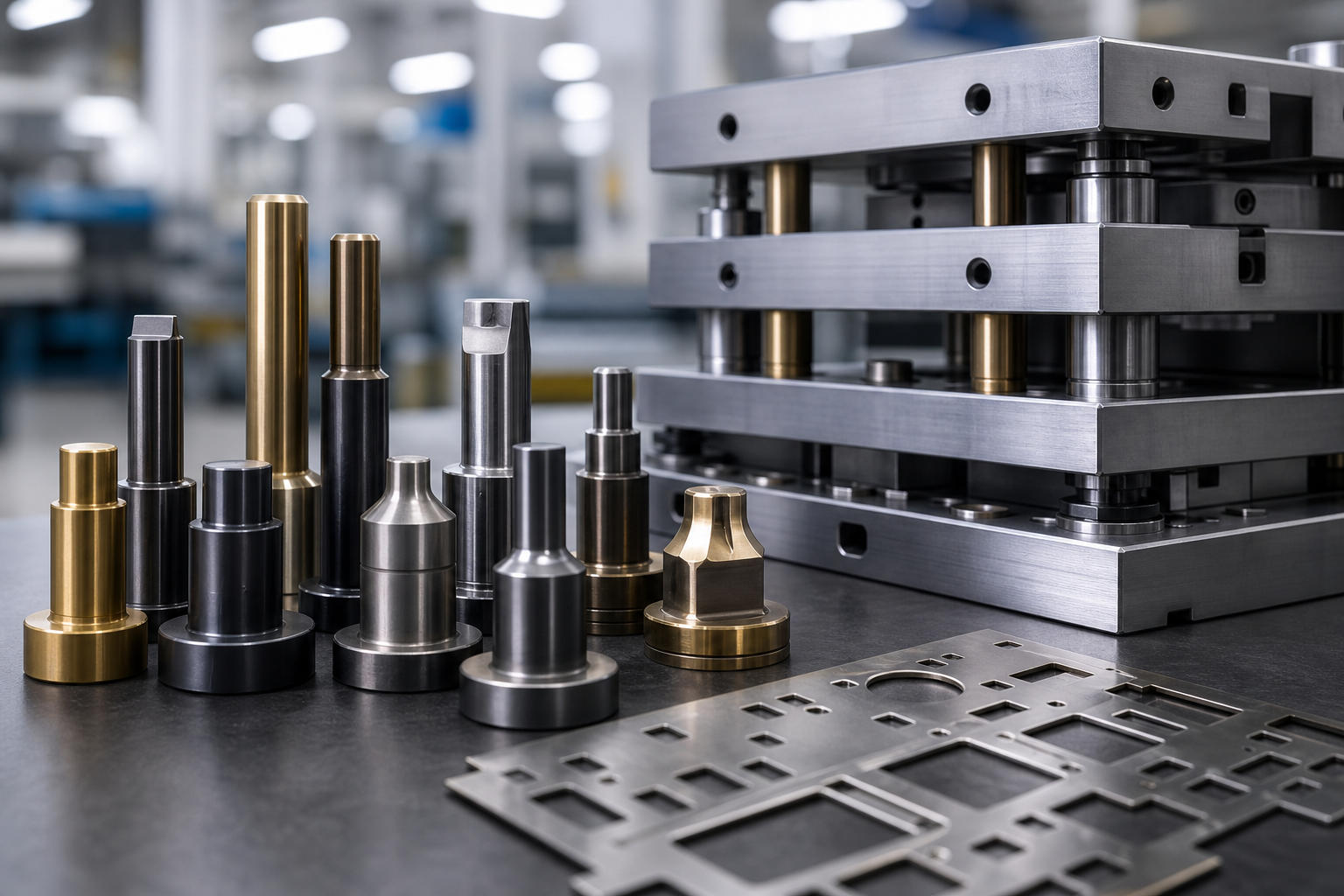
Stamping die coatings guide for vendor prequalification
This stamping die coatings guide is written for manufacturing engineers, toolmakers, production managers, and procurement teams who need concrete checks before they specify or buy coatings. It lists the common specification and vendor-selection mistakes that shorten die life or cause stamped-part failures, and it gives the verification items to include in an RFQ, trial, or statement of work.
Why coating selection matters for stamping dies
Coatings on stamping dies must prevent a small set of failure modes that rapidly increase cost of ownership: galling and adhesive transfer, abrasive wear, surface build-up that alters forming geometry, and fatigue or chipping under cyclic loads. Choosing a coating only by advertised hardness or price is a frequent mistake. The correct coating architecture must meet chemical compatibility, mechanical property matching, stress accommodation, and adhesion to the die substrate so it helps the tool rather than harms it.
When stamping advanced high-strength steels, aluminum alloys, or coated sheets such as galvanized or aluminized material, sheet coatings and surface layers can be abrasive or sticky and create different wear mechanisms. Coatings selected for these applications must resist combined mechanical and chemical attack while keeping total cost of ownership favorable, not just minimize coating price per part. For an authoritative framework of architecture criteria see the design methodology for optimized die coatings on ScienceDirect: Design methodology for optimized die coatings. For practical industry examples on galling and wear in precision stamping dies, see this guidance: Overcoming galling and wear in precision stamping dies.
Check 1: match coating to die substrate and sheet material
Mistake to avoid: specifying a coating because it is “hard” without confirming chemical inertness and mechanical compatibility. A coating that is chemically reactive with the sheet surface or that generates high interface stresses can accelerate delamination or build-up.
- Ask for a substrate compatibility statement. The vendor should explain how the coating chemistry and process will behave against your specific die steel and the sheet alloy or coating, for example AHSS, galvanized, aluminized, or aluminum. Cite the forming process and material data sheets.
- Match mechanical properties. Hardness, toughness, and residual stress in the coating must be balanced for forming loads. Extremely hard, brittle layers can crack during deep draws or high-strain bends.
- Confirm thermal and chemical stability. Some coatings change properties during die maintenance or heat exposure. Verify thermal compatibility with any heat treatments or post-process operations.
Check 2: choose the right coating architecture and know the trade-offs
Mistake to avoid: assuming one technology fits every stamping challenge. Common options for stamping dies include PVD and DLC, and thermal spray variants such as pulsed HVOF. Each has trade-offs in hardness, toughness, adhesion, and non-wettability.
- PVD and DLC coatings provide low friction and excellent surface finish for forming tools where adhesive transfer and galling are primary concerns. They are often selected where non-wettability and a low coefficient of friction reduce material build-up.
- Thermal spray and pulsed HVOF provide thicker, more ductile layers that can resist abrasive wear and provide a sacrificial thickness on high-abrasion dies. They are a better match when you need a thicker deposited layer but must manage surface finish and dimensional changes.
- Multi-layer architectures or combinations of processes can be necessary. The optimized die-coating architecture should address chemical inertness, mechanical and physical properties, stress accommodation, and substrate compatibility as a system, not as a single property.
Decision flow: if galling and adhesive build-up dominate, prioritize low-friction PVD or DLC architectures. If abrasive wear or high material removal rates dominate, evaluate pulsed HVOF or thermospray solutions. Always require vendor justification for the chosen architecture with comparative test data.
Check 3: verify adhesion data and inspection reports before approval

Mistake to avoid: accepting vague statements such as “excellent adhesion” without documented tests. Missing or incomplete adhesion data is one of the most frequent causes of early failure after recoats or in production scale-up.
- Request specific adhesion and quality proofs: scratch or indentation test results, cross-sectional microscopy showing the coating/substrate interface, and sample images of failed and accepted parts.
- Require process repeatability data: results from at least three consecutive cycles showing consistent thickness, hardness, and adhesion metrics for the same part geometry.
- Ask for inspection limits and acceptance criteria that will be used on your parts, not generic internal specifications.
Check 4: ensure surface preparation steps are specified and in-house
Mistake to avoid: sending dies to a coater without a full written specification for surface preparation. Skipped or inconsistent prep is a leading cause of poor adhesion and patchy coatings.
- Mandate the full process chain in the contract: degreasing, masking, sandblasting or microblasting where required, stripping of previous coatings, and cleaning procedures.
- Prefer vendors that perform critical prep steps in-house. Fragmented supply chains increase handling risk and introduce process variability.
- Define contamination control and handling rules for returned tooling, including packing, humidity control, and traceability for high-value dies.
Check 5: plan for post-coating finishing and dimensional control
Mistake to avoid: approving a coating without agreeing how you will meet final tolerances. Deposited layers change dimensions and sometimes surface roughness, so finishing plans matter.
- Specify post-coating operations you require, for example lapping or after-coating polishing, and who is accountable for final dimensions and surface finish.
- Agree on dimensional budgets for deposited thickness and any material removal. If critical features cannot tolerate added thickness, include step grinding, EDM touch-ups, or lapping in the scope.
- Request typical surface roughness before and after coating on representative parts so you can validate forming surface friction and release performance.
Check 6: confirm scaling capability and batch consistency for production

Mistake to avoid: using a single successful prototype run as proof of production readiness. Scale-up problems are common unless the vendor documents capacity, cycle weights, and in-line quality control.
- Ask about cycle capacity and batch weight limits so your part mix can be processed consistently. Vendors that own high-capacity machines can reduce the risk of unexpected rework. For example, Sputtek documents SPUN systems designed for larger batches; check the vendor data for machine capacity and cycle handling on their website: Sputtek.
- Require pilot-run reporting: thickness maps, hardness distribution, and adhesion checks across the batch so you can compare production results to the prototype.
- Confirm in-house QC lab capabilities for cross-sectioning, hardness mapping, and failure analysis to support rapid root-cause resolution during scale-up.
Check 7: vendor prequalification items and logistics for Canadian buyers
Mistake to avoid: skipping vendor credential verification and assuming a regional vendor meets regulated supply chain requirements. For regulated or safety-critical programs, check certifications and approvals upfront.
- Request copies of relevant certifications such as ISO 9001:2015 and any industry vendor approvals required by your supply chain. If you need nuclear vendor approval or similarly stringent credentials, ask for the certificate details early in the RFQ. The Sputtek corporate profile lists ISO 9001:2015 and Nuclear N299.3 approval as credentials to verify when working with a Canadian supplier.
- Obtain a list of in-house services you expect the vendor to perform: sandblasting, microblasting, degreasing, stripping, polishing, lapping, and a QC laboratory for tests and sample reports.
- Define pilot-run terms and acceptance criteria in the statement of work: sample size, test matrix, reporting format, and responsibility for tool shipping and handling. Clarify lead-time assumptions and packaging or return shipping rules so dies arrive and return in production-ready condition.
Stamping die coatings pre-qualification checklist
Use this one-page checklist to include with an RFQ or trial request. Mark each item as required, optional, or not applicable for your program.
- Material and forming conditions: sheet alloy, coatings, lubricants, draw depth, cycle rate
- Specified coating technology and alternative options you will accept (PVD, DLC, pulsed HVOF)
- Substrate prep: degrease, sandblast or microblast, mask, strip schedule
- Adhesion proofs required: scratch tests, cross-section images, process repeatability data
- Thickness and hardness targets, plus allowable dimensional change
- Post-coating finishing: lapping, polishing, EDM touch-ups, responsibility assignment
- Pilot-run sample size, reporting format, and pass or fail criteria
- Certifications required: ISO 9001:2015, N299.3 or other industry approvals
- Handling and packaging rules for tooling, including return transit expectations
Frequently asked questions
How do coatings reduce galling and adhesive build-up in stamping dies
Coatings reduce galling by lowering surface energy and friction, creating non-wetting interfaces, and providing a harder or chemically inert surface that resists transfer from the sheet. Low-friction PVD and DLC architectures are commonly used for this purpose. For design guidance on combining chemical inertness and mechanical properties, consult the technical literature on die coating design: Design methodology for optimized die coatings.
When should I choose PVD or DLC over pulsed HVOF for a stamping die
Choose PVD or DLC when adhesive transfer, friction, and surface release are the dominant issues and when tight final tolerances are required. Choose pulsed HVOF when abrasive wear and thicker sacrificial layers are primary concerns. In many applications a documented pilot comparison helps decide which architecture meets your total cost of ownership goals.
What adhesion tests and reports should I insist on from a coating vendor
Insist on scratch or indentation adhesion tests, cross-sectional microscopy of coated samples, and process repeatability data across multiple cycles. Require clear acceptance criteria and example reports that show how the vendor manages adhesion failures and what corrective actions are taken.
What mistakes in surface preparation most often cause early coating failure
Common mistakes include insufficient degreasing, inconsistent blasting media or pressure, failure to remove previous coatings completely, and outsourced prep steps without traceability. Specifying and auditing in-house preparation steps reduces these risks.
What documents and pilot data should I require to qualify a coating vendor for production
Require certification copies for example ISO 9001:2015, a detailed list of in-house services, pilot-run data such as thickness maps, hardness distribution, and adhesion checks, and defined acceptance criteria in the statement of work. Explicit handling, packaging, and shipping requirements should also be documented to protect tooling during transit and handling.
Key sources cited in this article include the die-coating design methodology on ScienceDirect for architecture criteria and industry guidance on overcoming galling and wear in precision stamping dies for material and process specific failure modes. For supplier credentials and facility capabilities, review the vendor’s published information.
Ready to request trial parts or an RFQ using the pre-qualification checklist above? Contact Sputtek to discuss PVD, DLC, or pulsed HVOF options and to confirm certifications and production capacity on their SPUN systems: Sputtek.