

Canada PVD company: 9 checks to verify certifications and capacity
What a Canada PVD company is and why it matters
A Canada PVD company provides physical vapor deposition and related surface engineering services from facilities located in Canada. These suppliers commonly offer PVD, DLC variants, and thermal spray processes such as Pulsed HVOF, and they serve applications where wear, friction, and corrosion reduce uptime and increase operating cost.
Choosing the right vendor is both a procurement and engineering decision. For regulated industries and OEM supply chains, the choice affects compliance, traceability, batch consistency, and the ability to scale from prototypes to thousands of parts. When a supplier advertises certifications or specialized systems, confirm those claims with documented evidence rather than relying on marketing language.
The 9 checks procurement teams must perform
Use this checklist during supplier prequalification, RFI, or RFQ stages. For each item, the verification prompt explains what document, sample, or test to request before you award business.
1. Certifications and regulated‑sector approvals to verify
What to check: request current certificates and scope descriptions for quality and sector approvals. Examples include ISO 9001:2015 and Nuclear N299.3 where nuclear supply chains require specific vendor approval. Accept copies of certificates, the issuing body, the certificate number, and an expiry or reissue date.
How to verify: confirm certificate details with the issuing registrar and ask for evidence of processes that map to the certificate scope, for example documented quality manuals or process flow charts. Record your verification steps and decisions for auditability and governance review, following a structured due diligence checklist where appropriate. See government guidance on due diligence and board screening for structured approaches to verification.
Verification prompt: ask for a signed scope statement, a recent internal audit report, and the certificate number so you can cross‑check with the issuing body.
2. Processes and materials offered
What to check: ensure the supplier performs the specific coating families you need. PVD covers metal, nitride, and ceramic films; DLC covers diamond‑like carbon variants for low friction; and thermospray or Pulsed HVOF provides thicker, wear‑resistant overlays. Each method addresses different failure modes, so document which failure mode you need to solve and match it to the process. For related first-party details, review PVD Coating Companies: Boost Part Life & Cut Wear in.
How to verify: request process data sheets, typical coating chemistries, and sample lists of parts already coated with the same process. Ask for recommended substrate preparation and the range of compatible base materials. For a supplier overview, review the company’s capability statement or a regional comparison of PVD providers to narrow candidates.
Verification prompt: ask for a process specification, recommended precoat surface finish, and a list of compatible substrates and maximum allowable part dimensions.
3. In‑house pre‑ and post‑processing capabilities
Why this matters: fragmented supply chains increase lead time and introduce variability. In‑house blasting, microblasting, degreasing, stripping, polishing, and lapping reduce handling risk and improve reproducibility.
How to verify: request a list of in‑house services and a floor plan or photos showing dedicated preparation cells. Ask how nonconforming surface preparation is flagged and corrected, and whether the vendor performs these steps under the same quality system as the coating operation.
Verification prompt: require a written flow of the preparation and finishing stages, including control points and acceptance criteria.
4. Machine capacity, batch sizes, and fixture capability
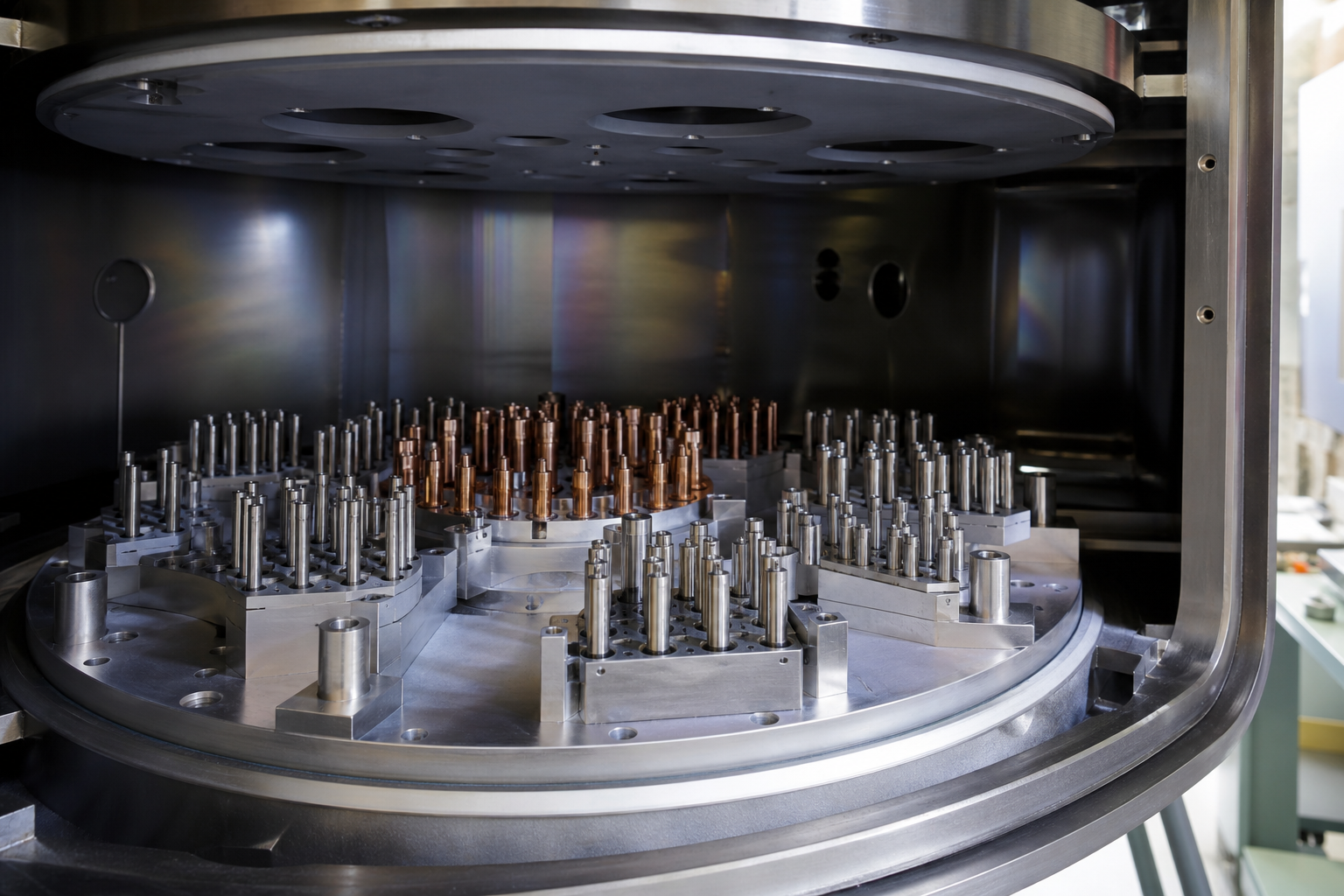
What to check: obtain system names and capacities, maximum part mass per cycle, and fixture options. Large volume buyers must confirm that machine throughput scales to planned volumes and that fixtures can hold your geometry repeatably.
How to verify: request declared machine models and cycle capacities, sample fixture drawings, and typical batch composition examples. If the vendor markets high‑capacity systems, confirm those numbers with technical specifications and a capacity worksheet showing worst‑case throughput, expected lead time per batch, and contingency for breakdowns.
Verification prompt: ask the supplier to show a capacity worksheet that maps your forecast to expected cycles per week and expected turnaround for each volume tier.
5. Quality control, testing, and traceability
What to check: request the list of tests the supplier runs routinely and on request. Essential items include coating thickness, hardness, adhesion, and where relevant, tribology or wear testing. Traceability should include batch identifiers and a method to map coated parts back to a process lot.
How to verify: ask for a sample certificate of analysis or inspection report that shows the test method, instrument, operator, and results. Confirm which tests are performed in‑house and which are sent to third‑party labs, and whether the supplier maintains a QC laboratory for routine checks.
Verification prompt: specify expected report fields in your RFQ and require that the supplier submit a recent inspection report from a part similar to yours.
6. Prototype experience and scale‑up evidence
What to check: proof that the supplier can move from prototype to production without losing consistency. Look for pilot run data, process control plans, documented change control, and references from similar industries.
How to verify: request a documented pilot run that shows sample size, control charts where available, and post‑pilot modifications to fixtures or parameters. For regulated buyers in automotive or aerospace, ask for references from Tier 1 clients or examples where the supplier supported a design change through scale up.
Verification prompt: ask for one or two pilot run reports and a short description of lessons learned and corrective actions applied.
7. Data, IP, privacy, and Canadian procurement considerations
What to check: ensure your contract protects technical data, tooling IP, and personal information. Public and private sector buyers should define data ownership, permitted uses of technical drawings, and restrictions on cross‑border transfer of personal information.
How to verify: include privacy clauses and technical data agreements in your RFP. Canadian government guidance highlights evaluating privacy protections and whether contracts should prohibit disclosure or transfer of personal information outside Canada without prior approval, so adopt the relevant contractual language and document the vendor response. See official guidance on taking privacy into account when making contracting decisions for wording examples.
Verification prompt: ask the supplier to confirm acceptance of your standard data protection clauses or to provide a redlined proposal for review.
8. Commercial terms, lead times, and logistics
What to check: collect the supplier’s standard lead times for prototype and production batches, minimum order quantities, pricing tiers by volume, warranty or remedial commitments, and logistics from their facility to your plant.
How to verify: require a turnaround table in the RFQ that separates prototype, small batch, and production runs. Request nonconformance procedures and SLA terms for expedited jobs. If the supplier is local to the Toronto area, clarify pickup and delivery options and whether they can support vendor‑managed inventory or kanban.
Verification prompt: include a statement of typical lead time ranges and the specific conditions that change those ranges, for example part complexity or surface preparation time.
9. References, case evidence, and site visits

What to check: ask for references from clients in your industry, and request permission to view pilot results or arrange a site visit. Evaluate uptime, operator skill, and whether the supplier documents deviations and corrective actions.
How to verify: prepare a short site visit checklist that inspects plate handling, fixture storage, lab instrumentation, and housekeeping. When a physical visit is not possible, request a live virtual tour with annotated footage of the coating line, fixtures, and QC lab.
Verification prompt: require two industry references and a recent sample test report from a similar part.
How to verify claims: documents, tests, and a sample trial
Practical steps: 1) collect certificates, scope statements, and recent audit reports; 2) request sample inspection reports that include method, instrument, and operator; 3) run a controlled sample trial to your pass/fail criteria; 4) compare results to the supplier’s claims. Make acceptance criteria explicit in the RFQ and capture them in the purchase order or technical agreement.
Sample trial design: send representative parts, specify surface finish and fixturing requirements, list required tests and pass limits, and agree on the report format. Use the trial to evaluate adhesion, thickness uniformity, and functional performance under an agreed load or cycle test if relevant.
Decision criteria and common procurement objections
Use a simple weighted scoring matrix that includes certifications and approvals, process fit, capacity, QC capability, sample trial results, commercial terms, and supply risk. Common objections are higher per‑part cost for premium coatings and longer lead times. Counterbalance these by estimating total cost of ownership, including tool life extension and reduced downtime, and by verifying lead time with pilot runs and contingency plans.
Sample RFQ checklist and next steps
- Attach required certificates and scope statements
- Provide process data sheets and typical chemistries
- Include capacity worksheet and fixture examples
- Submit a recent inspection report and traceability sample
- Confirm acceptance of data and IP clauses
- Quote prototype and production lead times separately
- Offer two industry references and permission for site visit
When you are ready, request a capabilities datasheet and a sample trial to see how the supplier performs against your acceptance criteria. For supplier overviews and comparison support, review the company’s published capability pages to help narrow candidates. For a Canadian provider’s service overview, consult their PVD capability statement.
Frequently asked questions
How do I verify a PVD vendor’s ISO 9001 and Nuclear N299.3 claims?
Request copies of the certificates, including the issuing registrar, certificate numbers, scope statements, and recent internal audit outcomes. Cross check the certificate details with the issuing body and ask for process documents that map the supplier’s procedures to the certificate scope. Use a formal checklist when confirming eligibility for regulated contracts and retain verification records for audit purposes.
When should I choose PVD or DLC instead of thermospray or pulsed HVOF for wear resistance?
PVD and DLC excel when you need thin, low friction, or hard surface films with precise thickness control and tight dimensional tolerance. Thermospray and Pulsed HVOF are better for thicker overlays where bulk wear resistance is required and surface roughness is acceptable. Choose based on the failure mode, allowable coating thickness, and the required dimensional tolerance, and ask suppliers for performance data on comparable parts.
What sample tests should I request before approving a production run?
Typical tests include coating thickness, hardness, and adhesion. For functional assurance add wear or tribology tests if friction or sliding wear is the failure mode. Require full traceability in the sample report and a signed inspection certificate from the testing technician.
What capacity and lead‑time information is essential for high‑volume coating contracts?
Request machine model and cycle mass limits, fixtures per cycle, expected throughput for planned batch sizes, scheduled downtime for maintenance, and escalation plans for breakdowns. Require distinct turnaround numbers for prototype, small batch, and production volumes and a contingency plan for supply interruptions.
Which contract clauses protect IP and data when working with a Canadian PVD company?
Include technical data ownership clauses, non disclosure agreements for tooling and process parameters, and explicit limits on the transfer of personal information. For public procurement, reference Canadian privacy guidance and require the supplier to accept data handling clauses that prevent unauthorized cross‑border transfers without approval.
Contact for a technical evaluation or sample trial
If you would like a capabilities datasheet or to schedule a sample trial, contact Sputtek for a technical evaluation and procurement package tailored to Canadian buyers. Request a capabilities datasheet or start a trial on Sputtek’s site, or review their PVD capability page for more details.
Relevant references: official government guidance on due diligence and privacy in contracting can help structure your evaluation and contracting steps. Verify vendor certification claims with documented evidence supplied by the vendor and cross‑checked with the issuing registrar.