
If your parts fail from abrasion, impact, corrosion, or require reclamation, understanding thermospray coating benefits helps you choose the right process and vendor. This article compares thermospray, including Pulsed HVOF, with PVD, DLC, and plating by failure mode, lists the technical tradeoffs you must manage, and gives an actionable vendor checklist for regulated industries. For industry context on thermal spraying see the Welding Institute summary and for local capabilities see Sputtek’s thermospray services.
What thermospray is and key variants
Thermospray, commonly called thermal spraying, is a family of coating processes that melt or heat feedstock material and project it onto a substrate to form a protective overlay. Common variants include wire arc, flame spray, HVOF, and Pulsed HVOF. Pulsed HVOF is a high-velocity oxy-fuel process that uses short combustion pulses to deliver dense, well-bonded deposits with lower porosity than many other spray methods. For a concise benefits summary see the Welding Institute and Sputtek’s thermal spraying page.
Short process descriptions
- Wire arc and flame spray: lower particle velocity, suited to thicker overlays and reclamation where deposition rate matters.
- HVOF: high particle velocity, producing dense coatings with good bond strength and wear resistance.
- Pulsed HVOF: a variant that produces very dense, low-porosity carbide and metal-ceramic overlays ideal for severe abrasive wear.
Typical coating thickness and materials
Thermospray thickness ranges from tens of micrometers up to several millimeters, depending on process and application. Materials include carbides, chromium and nickel alloys, oxides, and self-fluxing alloys. This material flexibility lets thermospray address both wear and corrosion problems that thin-film processes cannot.
Core thermospray coating benefits
Engineers choose thermospray when they need a broad material palette, thick dense overlays, or component reclamation that other thin-film processes cannot economically provide. The principal thermospray coating benefits are below.
Reclamation and surfacing
Thermospray can restore worn geometries by building deposits thick enough to be reworked, machined, or lapped back to specification. Reclamation often avoids expensive part replacement or the need for forged spares.
Abrasion and erosion resistance
Applied by HVOF or Pulsed HVOF, thermospray produces dense carbide and cermet overlays with high hardness and low porosity. Those characteristics translate to superior abrasion and erosion resistance in slurry, particulate, or high-velocity gas streams compared with many plating processes and most PVD films.
Corrosion protection and material selection
Thermal spraying accepts a wide range of chemistries, so you can select a material tailored to chemical exposure, from corrosion-resistant nickel alloys to ceramic barriers and sacrificial metallic overlays for cathodic protection. That material choice is one of the method’s main advantages.
Match failure modes to the right process
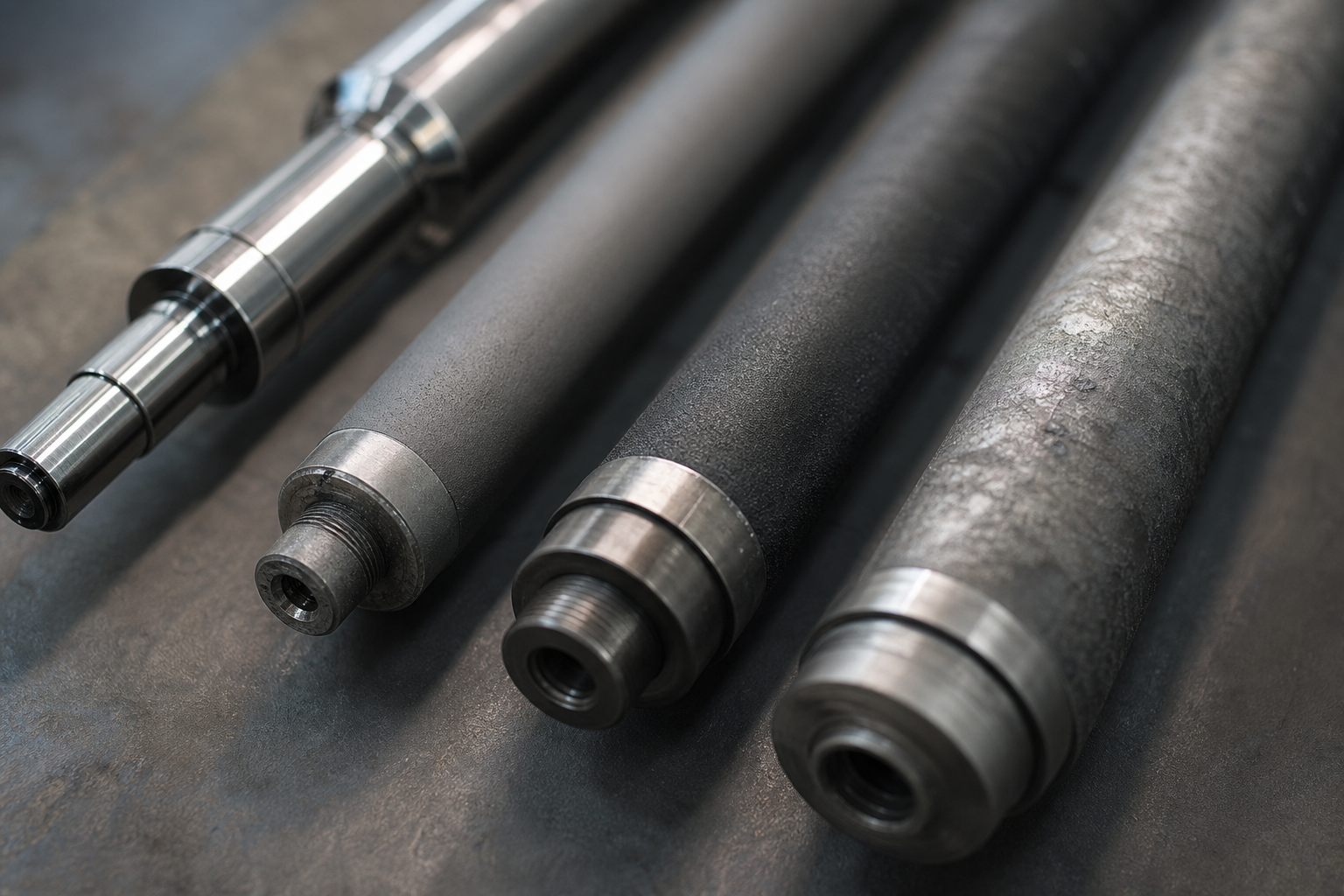
Use the practical failure-mode decision guide below to map common failure mechanisms to thermospray, PVD, DLC, or plating. Treat this as a starting point and always require test trials for final validation.
- Abrasion and erosion: Prefer Pulsed HVOF or HVOF thermospray for dense carbide overlays. PVD and DLC are very hard but thin, so they can fail rapidly under heavy abrasive loading.
- Adhesive wear and friction: Consider DLC or specialized PVD stacks, which provide very low coefficient of friction for sliding surfaces. Thermospray is less suitable for reducing sliding friction unless used with secondary treatments.
- Impact and cyclic fatigue: HVOF thermospray offers strong mechanical interlock and toughness for impact resistance, but watch for added mass and potential stress concentration. Thin PVD or DLC films minimize geometric change and are often preferred where fatigue is critical.
- Corrosion in aggressive environments: Thermospray enables thick corrosion-resistant barriers and flexible material selection. Plating remains a strong option where standardized plating specs and controlled thin layers meet the corrosion requirements.
- Reclamation and dimensional restoration: Thermospray excels because it can deposit millimeters of material that are then machined or lapped to tolerance. PVD and DLC cannot rebuild worn geometry.
Exceptions and nuances depend on contact pressure, surface speed, chemistry, temperature, and allowable dimensional change. For aerospace or nuclear parts, combine process selection with documented qualification trials and a written test plan.
Technical tradeoffs and process constraints
Specifying thermospray requires attention to substrate heat input, achievable surface finish, and inspection limits. Addressing these constraints up front reduces surprises during qualification.
Substrate compatibility and heat effects
Thermal spray introduces heat to the substrate and can affect temper, hardness, or dimensions. For heat-sensitive components, specify low-heat variants, staged spraying, or preheating and post-process stress relief. Ask your supplier for measured input energy data and demonstrated experience with your substrate.
Required surface preparation
Adhesion depends on proper surface preparation. Typical requirements include grit blasting to a specified roughness profile, thorough degreasing, and masking of features that must remain uncoated. Suppliers that offer in-house sandblasting, microblasting, cleaning, and degreasing reduce the risk of process handoffs and hidden defects.
Typical NDE and qualification tests
Common verification includes bond testing, porosity measurement, microhardness, and cross-sectional metallography. For regulated programs, require documented test methods, traceable records, and an on-site QC lab where possible. Thermospray providers should be prepared to supply these reports as part of qualification packages.
When to specify Pulsed HVOF rather than other thermospray options
Pulsed HVOF is the appropriate thermospray choice when you need a thin but extremely dense overlay that delivers maximum wear life while maintaining fine near-net geometry. It is often preferred where conventional HVOF or flame spray produce too porous a deposit for the service environment.
Part examples and typical use cases
- Valve seats, pump plungers, and impellers subjected to abrasive media.
- Extrusion tooling and mandrels that require hard, low-porosity surfaces for long production runs.
- Wear strips and forging dies that benefit from carbide-rich overlays with strong mechanical bonding.
Compared with PVD, Pulsed HVOF provides much greater thickness and mechanical robustness. Compared with standard HVOF, Pulsed HVOF typically achieves lower porosity and often improved bond performance for carbide-based materials.
Vendor and specification checklist for regulated industries

When evaluating suppliers for aerospace, nuclear, medical, or other regulated programs, require the items below to reduce procurement risk and compare vendors objectively. Sputtek’s published capabilities illustrate the level of evidence you should expect.
- Certifications: ISO 9001:2015 at minimum and any program-specific vendor approvals required by your customer or regulator.
- In-house preparation and post-processing: sandblasting, microblasting, degreasing, stripping, polishing, and lapping with traceable records.
- On-site QC laboratory: bond testing, hardness measurement, metallography, and documented test procedures.
- Prototype-to-production scalability: batch capacity, cycle weights, and demonstrated program references.
- Material traceability: consumable material data sheets, lot numbers, and change control procedures.
- Trial support: willingness to run sacrificial trials, provide process parameters, and deliver full test reports.
Common objections and how to evaluate them
- Will it stick? Ask for bond test data, blast profile records, and micrographs. A reputable supplier will supply pull tests and cross-section images on request.
- Will heat distort parts? Request measured heat input data and trial parts. Suppliers can run sacrificial trials to quantify distortion risk and recommend pre- or post-process remedies.
- Is it cost effective? Compare installed cost with lifecycle metrics such as tool change frequency, downtime, and scrap rate to calculate ROI instead of comparing only first-article price.
- Can it be repaired later? Confirm stripability, recoat procedures, and the capability to rework deposits with documented procedures.
How to run a short trial and measure ROI
Run a low-risk trial using the steps below. Define acceptance criteria before coating parts to keep trials conclusive and fast.
- Define the failure mode and baseline metrics, for example tool life in production cycles, measured wear volume, or time between unscheduled stops.
- Prepare representative sample parts and require the supplier to document surface preparation and process parameters.
- Specify test methods: wear cycles, hardness, bond testing, porosity, and any corrosion exposure tests your program uses.
- Collect baseline data on uncoated parts and parts coated by comparator processes such as PVD or plating.
- Run coated samples in production or in accelerated laboratory tests, then compare life-cycle cost metrics including downtime, scrap, and tooling replacement frequency.
- Use the trial results to write a production specification and acceptance criteria for scale-up.
Request copies of all test reports and process records for your quality file. Suppliers who support trials and provide transparent test data typically reduce qualification time and program risk.
Frequently asked questions
What specific wear and corrosion problems are thermospray coatings best at solving compared with PVD or DLC?
Thermospray is best for heavy abrasive wear, erosion, and reclamation because it can deposit thick, dense overlays such as carbides or nickel alloys. PVD and DLC excel at thin-film low-friction applications and where minimal dimensional change is required, but they cannot rebuild worn geometry or provide millimetre-scale corrosion barriers.
How does Pulsed HVOF performance differ from conventional HVOF and when is it essential?
Pulsed HVOF typically produces lower porosity and finer microstructures than conventional HVOF, which improves erosion resistance and bond strength. Specify Pulsed HVOF when you need a thin yet extremely dense carbide overlay for severe abrasive or erosive services.
What surface preparation and inspection methods should be required in a thermospray purchase specification?
Require grit blasting to a defined roughness profile, degreasing records, bond testing, porosity or density checks, microhardness, and cross-sectional metallography as needed. Vendors with in-house blasting and QC labs simplify traceability and reduce process handoffs.
Can thermospray overlays be machined or lapped to tight tolerances after coating?
Yes. Thermospray overlays are commonly machined, ground, or lapped to final geometry. Specify the post-coating process and tolerances on your drawing and confirm the supplier has the capability to perform or support those operations.
What certifications and in-house capabilities should I insist a supplier prove for aerospace, nuclear, or medical tooling programs?
Insist on ISO 9001:2015 at minimum and any program-specific vendor approvals required by your customer or regulator. Evidence of in-house prep and post-processing, an on-site QC lab, and documented traceability are essential. For an example of a supplier that publishes these capabilities see Sputtek’s service pages.
If you want supplier support for trials, specification review, or a quote from a thermospray provider with Pulsed HVOF and end-to-end in-house capabilities, contact Sputtek for sample trials and specification consultation. See Sputtek’s thermospray services and corporate site for more details.
Sputtek thermospray services • Sputtek • TWI thermal spraying overview