
Common mistakes that undermine PVD coating wear resistance
Engineering teams choose PVD coatings to reduce friction, resist abrasion, and extend tool life. Yet PVD coating wear resistance can fail in production when selection or supplier processes are wrong. This article lists the technical and vendor red flags that most reliably predict poor field performance, gives exact questions to ask prospective suppliers, and provides a short test program to expose likely failure modes before you commit to scale.
How PVD coatings reduce wear and where they can fail
Key mechanisms that drive wear performance
PVD coatings reduce wear by adding a hard, low-friction surface layer, by providing oxidation resistance at elevated temperature, and by using layered or graded architectures to improve load transfer into the substrate. For decorative and functional coatings alike, tribological properties such as friction and abrasion resistance control durability and appearance retention in service (review of PVD tribology).
Typical failure modes to watch for
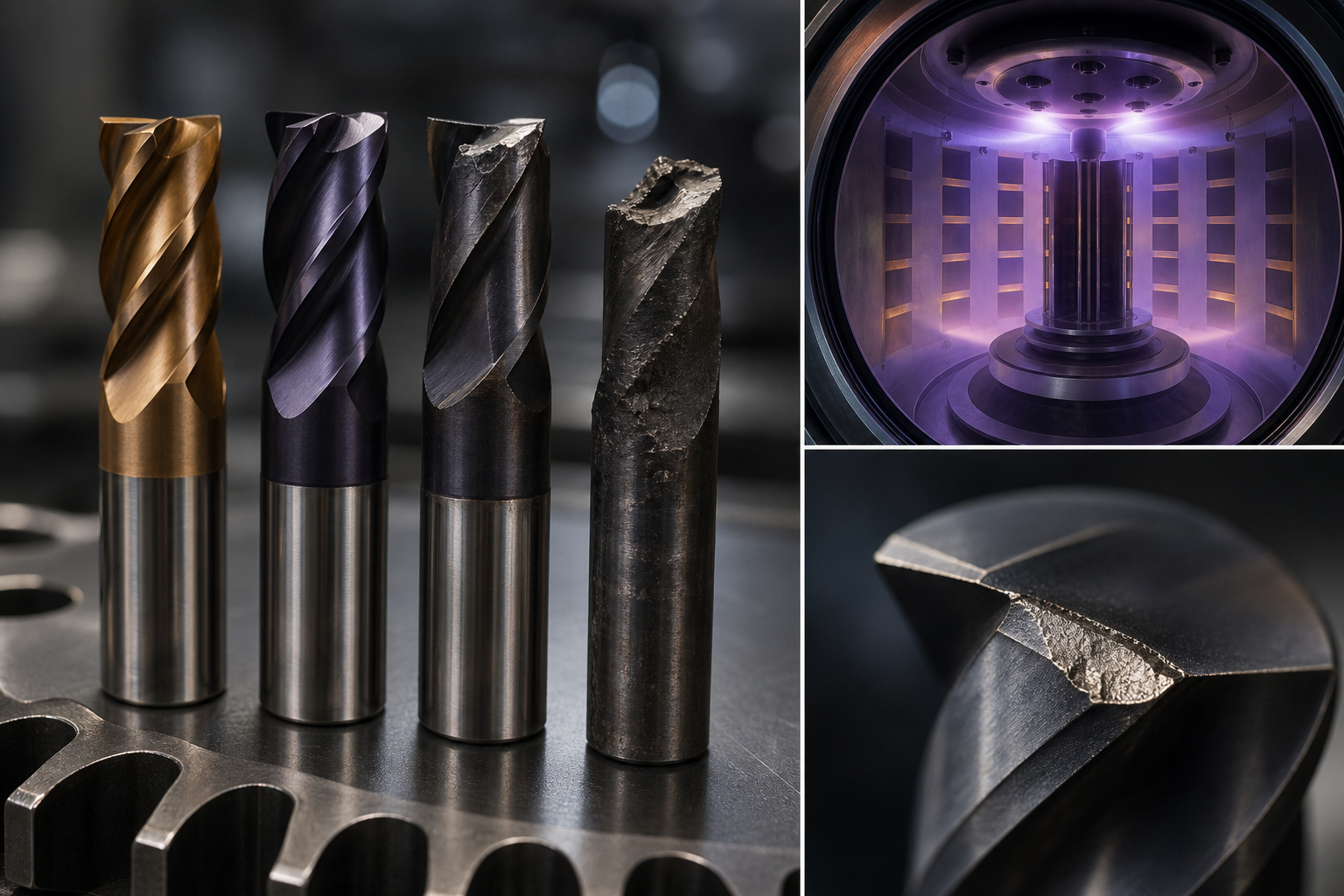
Common failure modes include abrasive delamination, fatigue at the coating/substrate interface, and oxidative breakdown at high temperature. Failures often start at sites of poor adhesion or where the thin hard layer cannot carry the applied load, producing rapid substrate exposure and accelerated wear (wear and erosion resistance study).
Why hardness alone is not decisive
Hardness is a useful indicator but not the whole story. Tests and literature show that coating architecture, substrate support, and oxidation resistance change micro-abrasion rates; for example, duplex and TiAlN-type coatings can outperform single-layer TiN even when hardness values are similar (micro-abrasion comparison). Expect suppliers who quote only hardness numbers rather than matched test data to be a red flag.
Top supplier and technical red flags that predict poor wear performance
Red flag: Relying on hardness alone as proof of wear resistance
Why it matters: Hardness does not capture load-bearing capacity, residual stress, or how a coating reacts under sliding or abrasive contact. Evidence shows that similar-hardness coatings can have widely different wear rates depending on composition and architecture (mechanisms study).
Indicators to spot: Datasheets with only Vickers numbers, or marketing that states a single hardness number as the reason a coating will last longer.
Red flag: Choosing a single-layer chemistry for a severe micro-abrasion application
Why it matters: Micro-abrasive testing indicates duplex TiAlN often gives lower wear than single-layer TiN. When the intended wear mode is abrasive rather than purely sliding, a layered or duplex architecture is frequently superior (duplex vs single-layer results).
Indicators to spot: Supplier recommends a one-size-fits-all TiN without comparative micro-abrasion or pin-on-disk data for your specific condition.
Red flag: Specifying an inappropriate thickness without load analysis
Why it matters: Too thin and the coating will quickly wear through; excessively thick coatings can have high residual stress and poor adhesion. The effective thickness depends on load, contact geometry, and substrate rigidity, not just a target micron value.
Indicators to spot: Flat thickness recommendations such as “3 micron for all cutting tools” without an explanation of how that thickness maps to expected contact stress or a test program.
Red flag: Skipping or outsourcing substrate preparation
Why it matters: Surface cleanliness, blasting profile, and preheating control adhesion. Poor or inconsistent preparation is a leading cause of early delamination. Canadian technical reports illustrate how adhesion and wear behaviour depend on proper pre-treatment for aerospace alloys and steels (NRC report).
Indicators to spot: Supplier cannot describe their blasting media, grit size, or contamination controls, or they rely on third parties for prep without documented process control.
Red flag: Weak adhesion and no test data
Why it matters: Adhesion failures make wear irrelevant because the coating lifts and exposes the substrate. The literature and standards recommend objective adhesion testing such as scratch and bend tests to quantify adhesion under expected loads (adhesion and failure mechanisms).
Indicators to spot: No scratch test data, no adhesion metrics, or refusal to run adhesion tests on representative parts.
Red flag: Ignoring the operating environment and load-bearing conditions
Why it matters: Wear mode matters. Impact and erosion often favour thermal spray or Pulsed HVOF approaches, while sliding with mild abrasion may be best served by specific PVD chemistries like Ti-Al-C-N for low friction and wear resistance (heat-treated PVD coatings).
Indicators to spot: A supplier recommends the same coating for impact, slurry erosion, and high-temperature sliding without discussing trade-offs or alternative processes.
Red flag: Supplier capacity or quality system gaps for scale-up
Why it matters: Small-batch coating procedures that are not reproducible will fail when you scale to production volumes. ISO 9001 and traceability matter for consistent results, especially in regulated sectors. A local supplier with in-house prep and QC reduces risk and iteration time (Sputtek capability overview).
Indicators to spot: No ISO certification, limited cycle capacity, or multiple outsourced steps without documented lot traceability.
Exact questions to ask suppliers and what answers should look like
Process and chemistry questions
- Which coating chemistries and architectures do you recommend for my wear mode, and why?
- Can you provide comparative micro-abrasion, pin-on-disk, or erosion data on the recommended options?
Good answer: A short rationale that cites test data comparing TiN, TiAlN, and duplex options for a matching wear regime, with numbers or referenced test reports.
Substrate preparation and batch handling
- Describe your blasting, cleaning, and handling steps, and where they occur in-house.
- How do you prevent cross-contamination and maintain batch traceability?
Good answer: Detailed media, grit sizes, cleaning chemistries, and a traceability flow. A local supplier that performs these in-house reduces handling risk and turnaround time; learn more about defining PVD processes locally in this primer Define PVD Coating In Woodbridge.
Adhesion and test data requests
- Provide scratch test results, bend test results, and microstructure cross-sections for similar parts.
- Are adhesion failures observed and how were they mitigated?
Good answer: Quantified scratch critical loads, bend pass/fail criteria, and representative cross-sections showing coherent interfaces.
Capacity, scaling and quality systems
- What is your maximum batch weight and per-cycle throughput?
- Do you hold ISO 9001 certification and do you provide lot-controlled documentation?
Good answer: Clear cycle capacities, ISO 9001 evidence, and a description of in-house QC and lab services that support repeatable production (company capabilities).
A minimal test program to expose likely failure modes before scale-up
Sample quantity and part selection
Order a small benchmark run: at least 5 to 10 representative parts that include the worst-case geometry and material. Include both critical and sacrificial locations so you do not risk production parts.
Adhesion tests
- Run a progressive scratch test to determine critical load for delamination.
- Perform a standardized bend or impact test on coated coupons if applicable.
Wear tests to request
- Micro-abrasion testing for abrasive contacts, or pin-on-disk for sliding wear, using loads and abrasives representative of field conditions (micro-abrasion evidence).
- Erosion or slurry tests for impact/particle-laden flows.
Thermal and corrosion checks
Run short thermal cycling and oxidation exposures if parts see high temperatures and standard corrosion tests when chemical attack is possible. Ti-Al-C-N style coatings show sensitivity to composition and heat treatment, so request treated sample data when temperature exposure is expected (heat-treated PVD behaviour).
When to prefer duplex, graded PVD, or Thermospray (Pulsed HVOF)
Duplex and graded PVD for micro-abrasion and sliding
Evidence shows duplex TiAlN architectures reduce micro-abrasion rates compared to single-layer TiN, making duplex designs a strong choice where fine abrasive wear dominates (duplex advantage).
Thermospray and Pulsed HVOF for impact and bulk erosion
When parts face heavy impact, particle erosion, or require thicker corrosion-resistant overlays, thermal spray or Pulsed HVOF can provide a more robust, thicker coating with different adhesion mechanics. Discuss trade-offs in surface finish and tolerances with your supplier.
Local considerations for Toronto and Ontario manufacturers
Working with a local GTA partner shortens iteration cycles and reduces logistics risk when you need fast turnaround on prototype runs or rapid rework. Require suppliers to document ISO 9001 status and in-house prep and QC capabilities to simplify approvals for regulated sectors. For a supplier overview and local process definitions, see this primer on defining PVD in Woodbridge Define PVD Coating In Woodbridge and the company capability summary Sputtek.
Quick decision matrix and immediate next steps
Short checklist for the next 30 to 90 days
- Request datasheets, scratch and micro-abrasion records for recommended chemistries.
- Order benchmark samples and require documented substrate prep details.
- Run the minimal test program described above and compare results to pass criteria agreed up front.
- Confirm supplier ISO 9001 status, capacity per cycle, and in-house QC lab capabilities.
Who to involve internally
Include design and process engineers, a materials scientist or metallurgist if available, and procurement for contractual traceability. Set go/no-go criteria based on adhesion loads, wear rate reduction relative to uncoated parts, and reproducibility across a small batch.
Frequently asked questions
How thick should a PVD coating be to improve wear resistance for cutting or stamping tools
There is no single optimal thickness. Typical wear-practical ranges are a few microns for cutting tools, but effective thickness depends on contact stress and substrate rigidity. Require the supplier to justify thickness with test data and a load analysis rather than accepting a blanket micron value.
What adhesion and wear tests should I require before approving a coating for production
At minimum: progressive scratch testing for adhesion, micro-abrasion or pin-on-disk for wear mode matching, and cross-section microscopy. Add erosion or slurry tests and thermal cycling when the service environment demands them.
When is thermospray or pulsed HVOF a better choice than PVD for wear protection
Choose thermospray or Pulsed HVOF when thickness, bulk impact resistance, or thicker corrosion overlays are required. For thin, low-friction surfaces and tight tolerances PVD is preferable. Evaluate based on test data that replicates your wear mode.
How can I tell if a supplier properly prepares and batches parts to avoid high scrap rates
Ask for a written pre-treatment flow, blasting media and grit size, cleaning chemistries, lot traceability records, and examples of in-house QC checklists. Suppliers that perform prep and coating under one roof reduce mixed-handling risk.
Which certifications and in-house capabilities should I prioritise when choosing a coating partner in Ontario
Prioritise ISO 9001 certification, documented adhesion and wear testing capability, in-house sandblasting and microblasting, and a QC lab that can run scratch and micro-abrasion tests. These capabilities materially reduce risk when scaling from prototype to high-volume production (company capabilities).
Final action: build a short supplier questionnaire from the questions above, require representative sample testing, and set objective pass criteria before you award production work. For local support and end-to-end in-house capabilities that can accelerate iteration and control risk, contact Sputtek.