Aluminum coating: compare processes, performance trade-offs, and practical selection steps
“Aluminum coating” can refer to two distinct ideas: applying a protective or functional layer onto aluminum substrates, or depositing aluminum (or aluminum-rich) layers onto other materials such as steels, superalloys, or polymers. Because goals vary—from corrosion protection to wear resistance, reflectivity, non-stick behavior, or high-temperature oxidation control—the right choice depends on matching a process to your part’s operating environment, geometry, and throughput needs. This article breaks down major process families, typical outcomes, and practical steps to arrive at a confident, defensible selection.
What “aluminum coating” covers
Before comparing processes, clarify the intent, substrate, and constraints. Aluminum coating work most often pursues one or more of the following:
- Corrosion protection in marine, humid, or chemically aggressive environments
- Wear reduction and lower friction in sliding or abrasive contact
- High-temperature oxidation control and diffusion barriers
- Optical performance such as high reflectivity or controlled emissivity
- Electrical behavior (conductivity, insulation, or shielding)
- Release/non-stick surfaces for forming, molding, or packaging tools
- Decorative and branding finishes with stable color and texture
Equally important are production realities:
- Batch size and takt time
- Part geometry, blind features, and line-of-sight limitations
- Masking complexity and critical tolerances
- Downstream finishing (lapping, polishing) and rework allowances
- Inspection needs such as thickness, adhesion, porosity, or surface roughness
Major aluminum coating process families
Processes fall into several widely used categories. Each has characteristic strengths, limitations, and typical applications.
Anodizing (on aluminum substrates)
Anodizing converts the surface of aluminum into a controlled oxide layer. It is not a deposited film; instead, the native surface is grown into a harder, thicker oxide with good corrosion resistance and, depending on the variant, improved wear resistance. Dyes can be incorporated for color. Common forms include decorative anodizing and more robust hard anodizing for tooling or mechanical components.
- Strengths: uniform coverage, integral bond (grown in place), corrosion resistance, color options
- Considerations: dimensional growth, potential brittleness at high thickness, conductivity changes
- Typical uses: consumer enclosures, machine components, molds and dies needing moderate wear resistance
Chemical conversion coatings (on aluminum substrates)
Conversion coatings form a thin, functional layer to enhance paint adhesion and provide baseline corrosion resistance. They are often selected when subsequent painting or powder coating is planned.
- Strengths: thin and conformal, good base for topcoats, simple processing
- Considerations: limited standalone wear resistance; usually part of a coating stack
- Typical uses: aerospace and electronics housings prior to paint or EMI shielding layers
Physical vapor deposition (PVD) of aluminum or aluminum-containing films
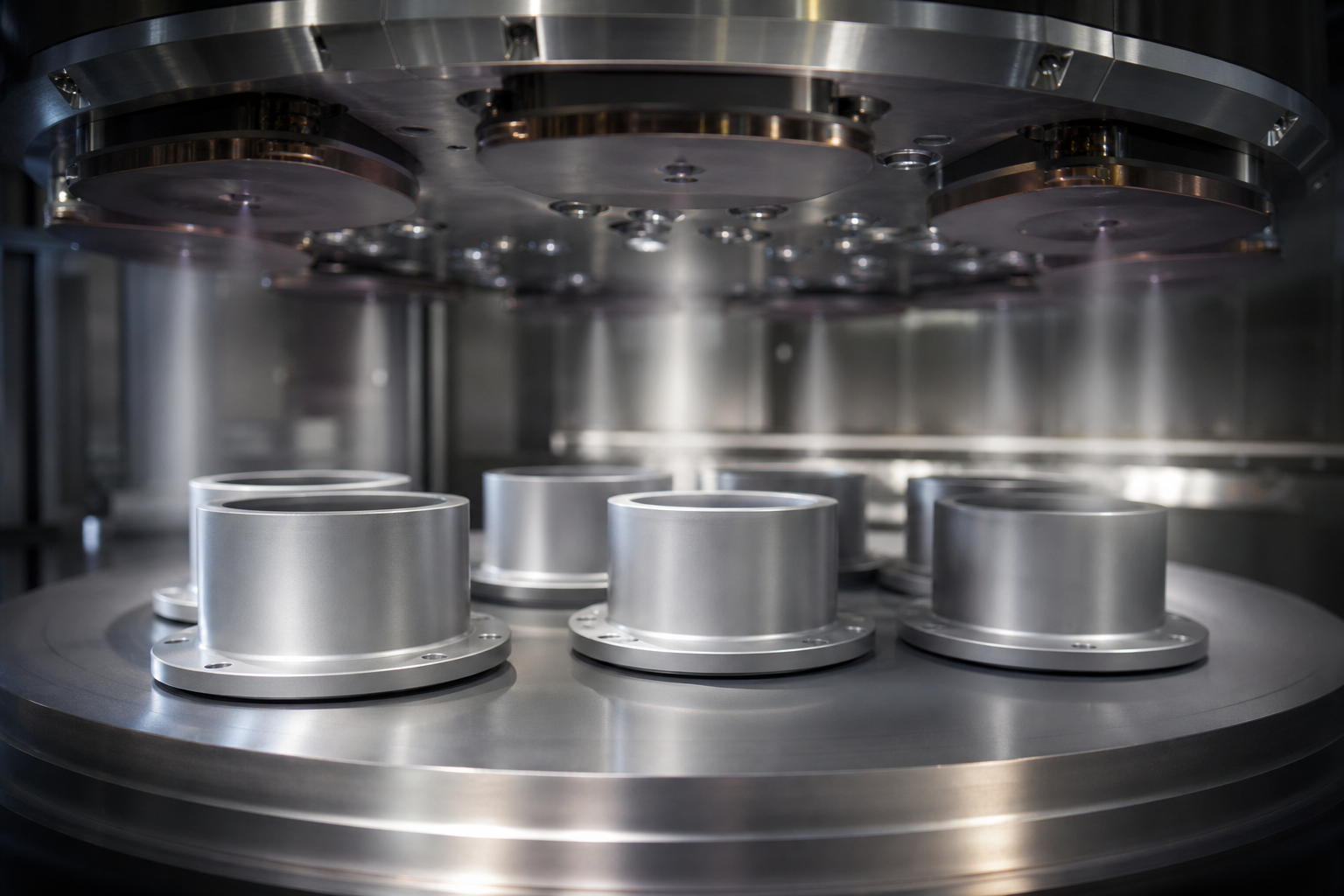
PVD is a vacuum process that deposits thin, dense films via sputtering or evaporation. For aluminum coating, this can mean pure aluminum for reflectors and shielding, or aluminum-containing compounds (e.g., for barrier, optical, or tribological targets). PVD is line-of-sight, so fixturing and part orientation matter.
- Strengths: excellent control of thickness and composition; high purity; strong adhesion on properly prepared surfaces
- Considerations: line-of-sight limits on deep recesses; masking and fixturing complexity; substrate temperature sensitivity
- Typical uses: optical reflectors, electronic shielding, precision tooling with engineered surfaces
Thermal spray (including high-velocity variants)
Thermal spray propels molten or semi-molten feedstock onto a surface to build relatively thick coatings. Aluminum and aluminum-bronze, as well as aluminum-ceramic blends, can be applied to achieve wear resistance, dimensional restoration, or corrosion protection. High-velocity methods tend to yield denser, better-adhered layers than conventional spray.
- Strengths: thick build capability; rapid deposition; broad material palette
- Considerations: surface roughening required for adhesion; porosity control is critical; post-spray finishing may be needed
- Typical uses: shaft repair, wear sleeves, corrosion barriers on steel components
Paints and powder coatings
Organic coatings provide color, corrosion resistance, and surface protection on aluminum or on aluminum-coated substrates. They are often paired with a conversion layer beneath for adhesion and longevity.
- Strengths: wide color/texture options; scalable for large parts
- Considerations: mechanical wear resistance is limited compared to inorganic films; curing windows and edge coverage need attention
- Typical uses: architectural panels, enclosures, consumer products
Aluminizing (aluminum on steel or other alloys)
When the substrate is not aluminum, aluminum-rich layers can be applied by diffusion processes or other methods to enhance oxidation and corrosion resistance. These create an interdiffused barrier layer that performs well at elevated temperatures.
- Strengths: improved high-temperature oxidation resistance; metallurgically bonded
- Considerations: thermal cycles during processing; dimensional and metallurgical effects must be managed
- Typical uses: exhaust components, hot sections, and process equipment
How to choose: a practical, defensible path
Rather than starting with a favored process, anchor your decision to verifiable operating conditions and measurable targets. The following steps help narrow the field quickly.
-
Define the dominant failure mode.
- Corrosion in salt or humidity exposures
- Abrasive or adhesive wear in sliding contact
- Thermal oxidation or diffusion at elevated temperature
- Optical degradation or loss of reflectivity
-
Quantify the environment.
- Temperature range and thermal cycling
- Media exposure (water, oils, solvents, acids/alkalis, particulates)
- Mechanical loads, contact pressures, and speeds
-
Match process families to needs.
- Anodizing or conversion + paint for baseline corrosion and decor
- PVD for thin, dense functional layers where purity, reflectivity, or precise thickness matters
- Thermal spray for thicker wear sleeves, restoration, or robust barriers on non-aluminum substrates
- Aluminizing for high-temperature oxidation resistance on steels
-
Check geometry and masking implications.
- Line-of-sight constraints for PVD
- Minimum corner radii, threads, and blind holes for spray access
- Critical bores or gauges that cannot tolerate buildup
-
Align with production constraints.
- Batch size and cycle times
- Fixturing complexity and changeover
- Inspection plan (thickness, roughness, adhesion) and rework strategy
Performance trade-offs you can expect
No single aluminum coating process dominates every metric. Anticipate and plan for these common trade-offs:
- Thickness vs. precision: Thermal spray builds thickness quickly but requires more finishing to meet tight tolerances; PVD provides fine thickness control but at thinner ranges.
- Line-of-sight vs. coverage: PVD yields highly engineered films where it sees the surface; complex cavities may need alternate processes or creative fixturing.
- Hardness and wear vs. toughness: Very hard films can be brittle; ensure the substrate hardness and support are adequate for contact loads.
- Corrosion resistance vs. mechanical wear: Some excellent corrosion barriers are relatively soft; pair with design features or topcoats when sliding wear is expected.
- Adhesion vs. rework: Stronger bonds usually mean more aggressive surface prep, which can complicate stripping or refurbishing.
Design and preparation details that pay off
Successful aluminum coating starts long before a part reaches a finishing line. Build these considerations into drawings and process sheets to reduce surprises.
- Surface condition: Specify incoming roughness where adhesion or friction matters. Know whether blasting, polishing, or lapping will be performed pre- or post-coating.
- Masking plans: Call out do-not-coat areas and masking tolerances. Include thread treatment and sealing approaches.
- Edges and radii: Sharp edges tend to thin film coverage and are wear hot-spots; small radii improve durability and coating continuity.
- Fixturing interfaces: Define handling points strong enough for vacuum or spray processes, and keep them away from critical surfaces.
- Venting and cleanliness: For vacuum processes, avoid blind volumes that trap gas. Across all methods, specify cleaning and degreasing requirements.
- Tolerances and buildup: Document expected thickness ranges and post-process finishing allowances on critical dimensions.
Inspection and QC you can standardize
Whatever process you select, close the loop with a measurable inspection plan. Common checks include:
- Coating thickness via appropriate methods for the material and thickness range
- Adhesion via standardized tests suited to the coating type
- Surface roughness before and after coating or finishing
- Porosity or density indicators for sprayed layers
- Appearance and coverage in masked transitions, edges, and recesses
- Functional tests aligned to the application (e.g., reflectivity for optical parts)
Common applications and quick pointers
- Optical reflectors and housings: Thin, high-purity aluminum via vacuum deposition; protect with suitable overcoats.
- Forming and molding tools: Hard anodizing for aluminum tools when moderate wear protection suffices; consider engineered films when friction control is critical.
- Dimensional restoration: Thermal spray aluminum or aluminum-bronze with post-spray machining to restore fits.
- High-temperature components: Aluminizing for oxidation resistance on steels and superalloys.
- Decorative finishes: Conversion coat plus paint or powder for color with baseline corrosion protection.
Troubleshooting and longevity
When aluminum coating underperforms, root causes usually trace to prep, geometry, or mismatch between process and environment. Watch for these signals:
- Edge wear or chipping: Sharp edges concentrating stress; add radii or adjust process.
- Underfilm corrosion or creep: Incomplete cleaning or poor sealing; tighten prep and post-treatment.
- Peeling or delamination: Insufficient surface roughness for sprayed layers or contamination before PVD; review blast media, cleanliness, and handling.
- Discoloration or loss of reflectivity: Environmental exposure beyond the coating’s design; add overcoats or change material stack.
- Out-of-tolerance dimensions: Unaccounted buildup or finishing stock; update drawings with realistic thickness windows.
FAQ
Is aluminum coating the same as anodizing?
No. Anodizing is a conversion process that transforms the surface of an aluminum part into a controlled oxide layer. Many other aluminum coating methods deposit new material on top of a substrate, including PVD, thermal spray, paints, and aluminizing on non-aluminum alloys.
Can plastic or composite parts receive an aluminum coating?
Yes, certain vacuum deposition methods can apply thin aluminum layers to polymers for reflectivity or shielding, provided the substrate can tolerate the process conditions and is properly prepared. Pay attention to adhesion promotion and thermal limits.
How thick should an aluminum coating be?
Thickness depends on function and process. Thin functional or optical films are often microns or less, while sprayed restoration layers can be orders of magnitude thicker. Specify a range that balances performance with dimensional control and finishing allowances.
What’s the difference between PVD aluminum and thermal-sprayed aluminum?
PVD produces thin, dense films with precise composition control and excellent purity, best for optical, barrier, or engineered-surface needs. Thermal spray builds thicker, more textured layers suitable for wear sleeves, restoration, or robust barriers, typically followed by machining or grinding.
Do I need a topcoat over an aluminum coating?
Often yes, especially for optical or decorative results or when the environment is harsh. Overcoats can protect against abrasion, chemicals, or handling damage, and they can tune friction or appearance.