Press Release January 10, 2025
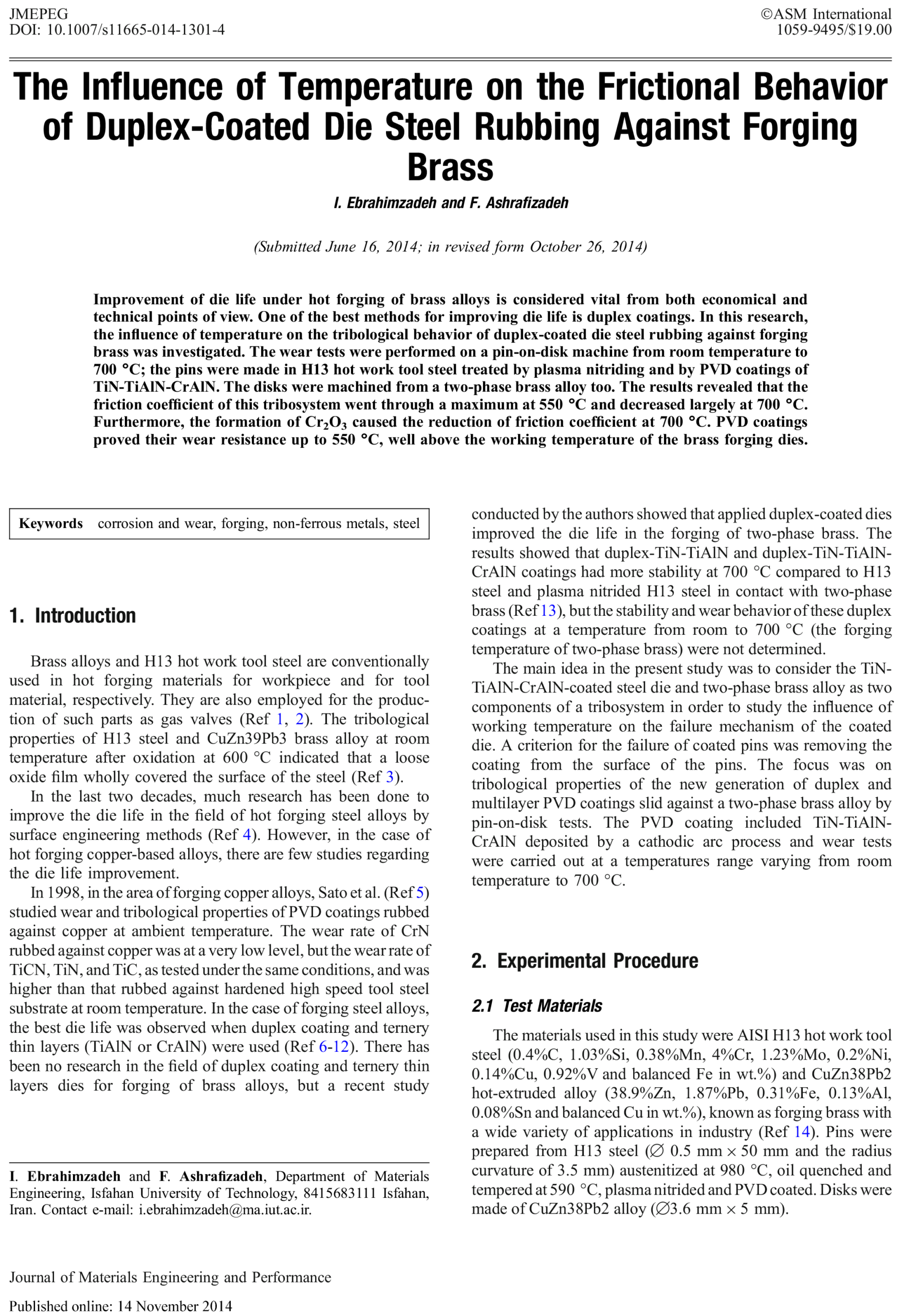
The Influence of Temperature on the Frictional Behavior of Duplex-Coated Die Steel Rubbing Against Forging Brass

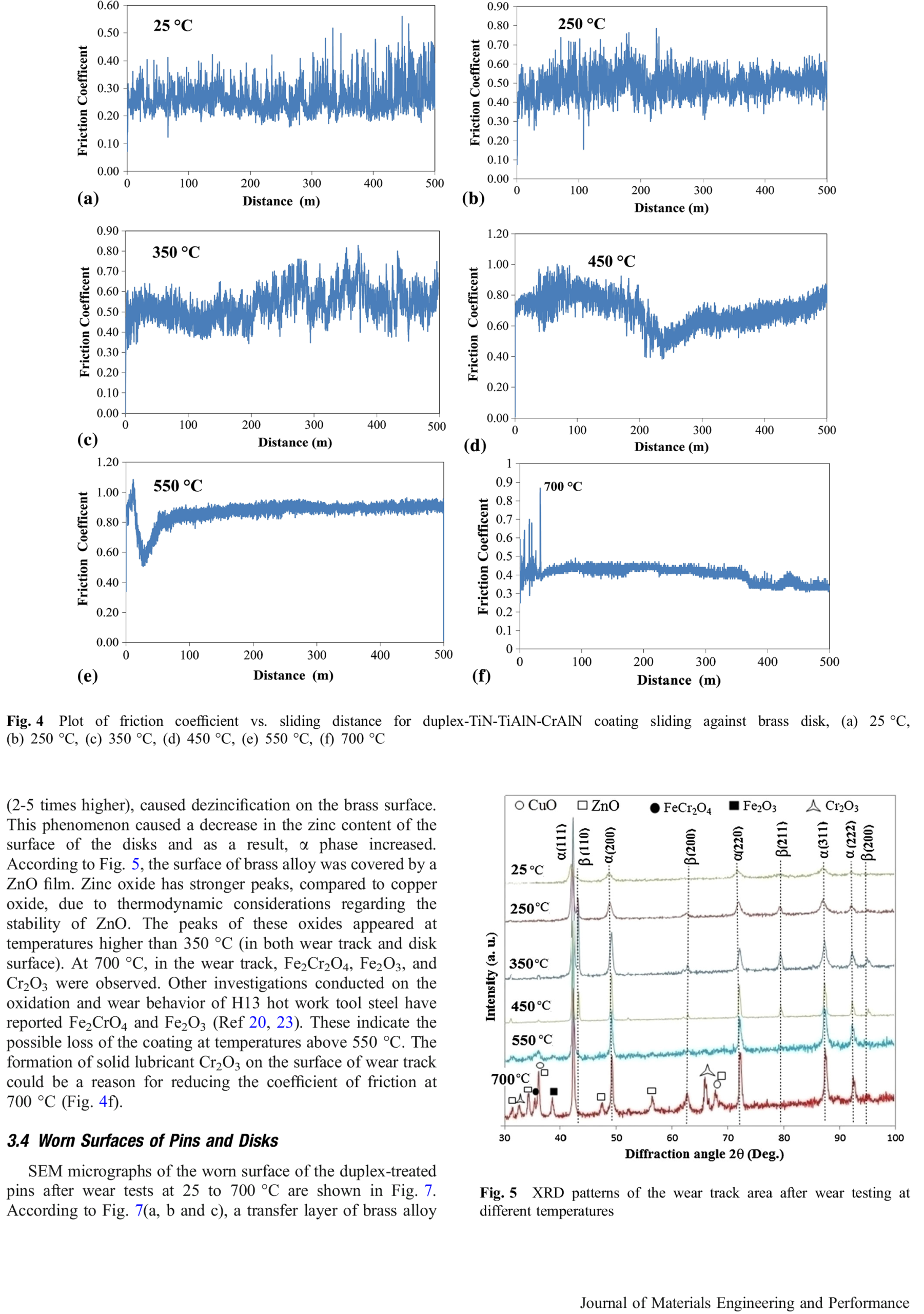
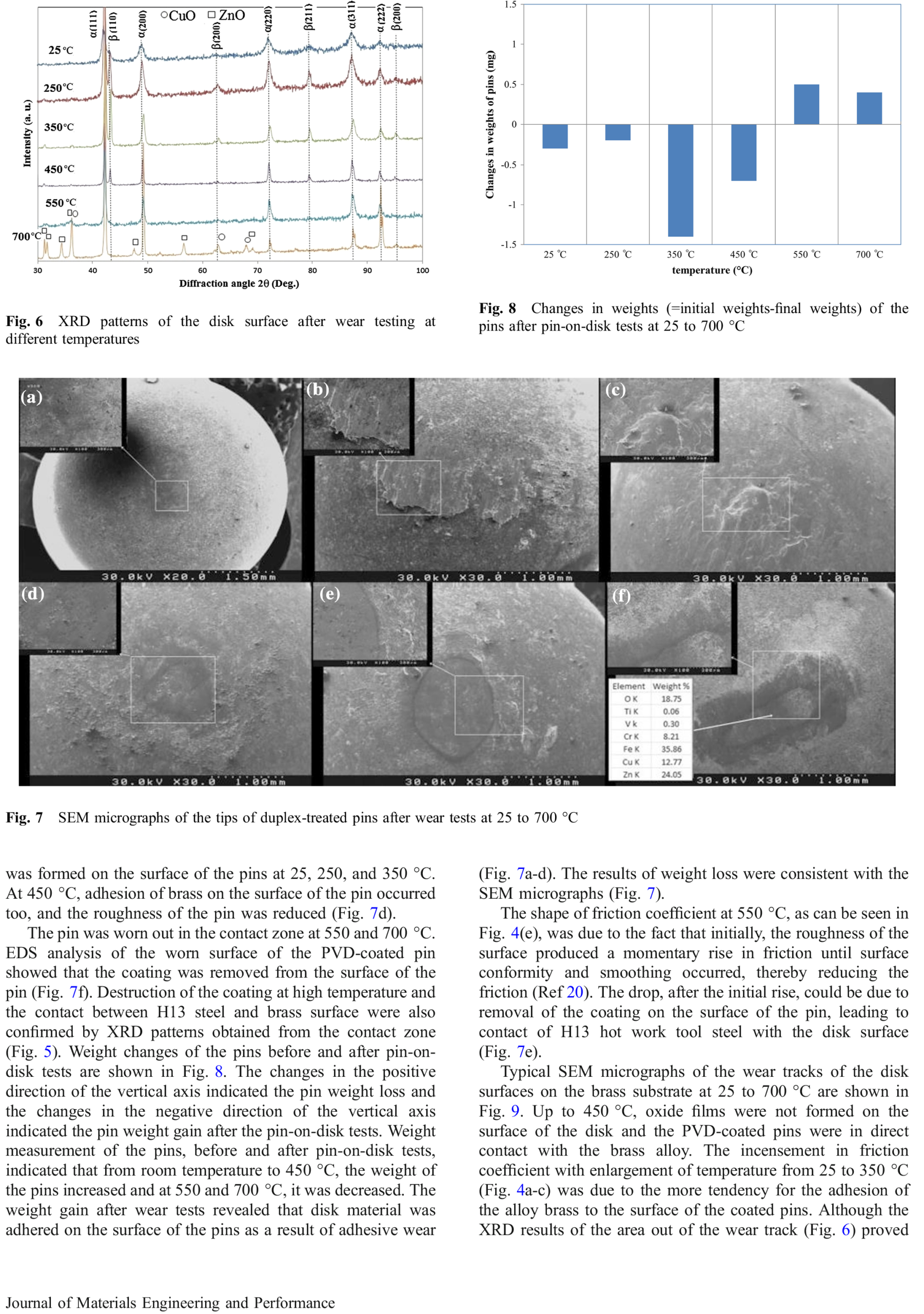
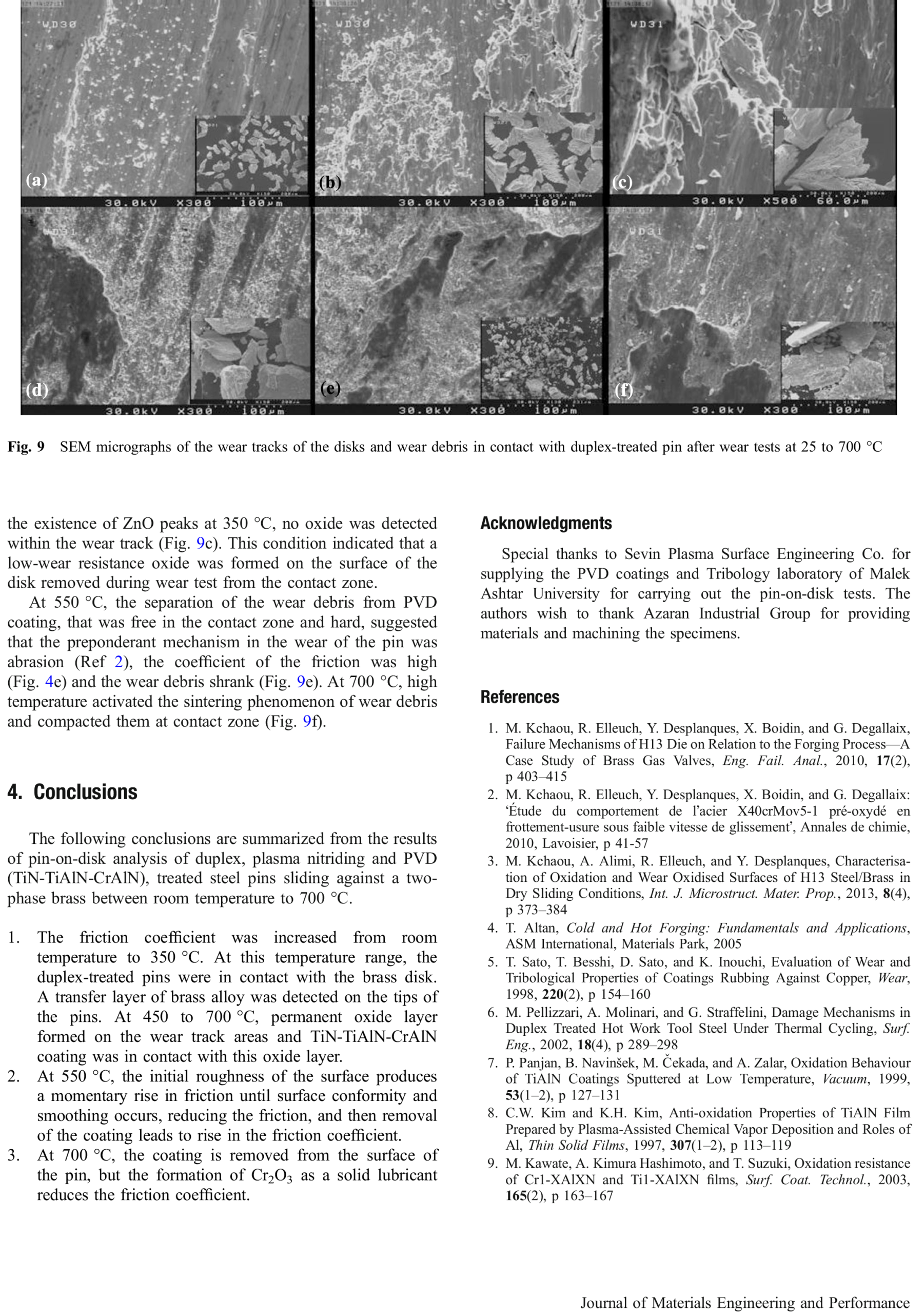
Improvement of die life under hot forging of brass alloys is considered vital from both economical and technical points of view. One of the best methods for improving die life is duplex coatings. In this research, the influence of temperature on the tribological behavior of duplex-coated die steel rubbing against forging brass was investigated. The wear tests were performed on a pin-on-disk machine from room temperature to 700 C; the pins were made in H13 hot work tool steel treated by plasma nitriding and by PVD coatings of TiN-TiAlN-CrAlN. The disks were machined from a two-phase brass alloy too. The results revealed that the friction coefficient of this tribosystem went through a maximum at 550 C and decreased largely at 700 C. Furthermore, the formation of Cr2O3 caused the reduction of friction coefficient at 700 C. PVD coatings proved their wear resistance up to 550 C, well above the working temperature of the brass forging dies.
1. Introduction
Brass alloys and H13 hot work tool steel are conventionally used in hot forging materials for workpiece and for tool material, respectively. They are also employed for the produc tion of such parts as gas valves (Ref 1, 2). The tribological properties of H13 steel and CuZn39Pb3 brass alloy at room temperature after oxidation at 600 C indicated that a loose oxide film wholly covered the surface of the steel (Ref 3).
In the last two decades, much research has been done to improve the die life in the field of hot forging steel alloys by surface engineering methods (Ref 4). However, in the case of hot forging copper-based alloys, there are few studies regarding the die life improvement.
In 1998, in the area of forging copper alloys, Sato et al. (Ref 5) studied wear and tribological properties of PVD coatings rubbed against copper at ambient temperature. The wear rate of CrN rubbed against copper was at a very low level, but the wear rate of TiCN, TiN, and TiC, as tested under the same conditions, and was higher than that rubbed against hardened high speed tool steel substrate at room temperature. In the case of forging steel alloys, the best die life was observed when duplex coating and ternery thin layers (TiAlN or CrAlN) were used (Ref 6-12). There has been no research in the field of duplex coating and ternery thin layers dies for forging of brass alloys, but a recent study
WHAT IS INDUSTRIAL AUTOMATION?
Industrial automation refers to the use of control systems—such as computers, sensors, PLCs, and robotics—to handle processes with minimal human intervention. Common forms include:
- Programmable Logic Controllers (PLCs) to manage production lines
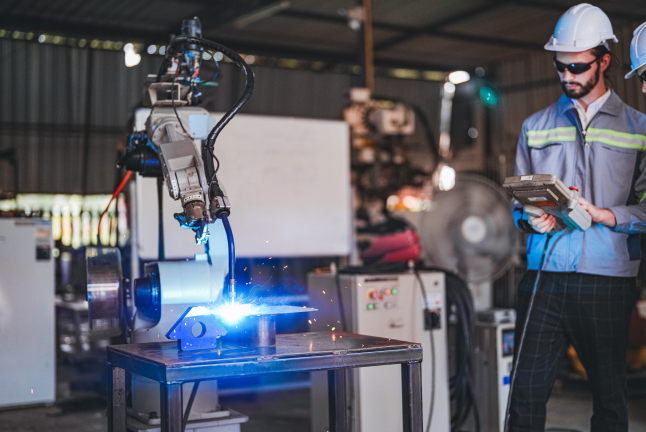
- Robotic arms for assembly, welding, and packaging
- Sensor networks for real-time process monitoring
- Machine vision systems to detect defects or direct robotic movements
- AI-powered predictive analytics for maintenance and quality control
These technologies help eliminate variability, reduce downtime, and maximize throughput—all while maintaining consistent product quality.
KEY BENEFITS OF MODERN AUTOMATION
Embracing automation opens the door to several key advantages:
- Higher Precision & Consistency: Machines perform repeated tasks without fatigue.
- 24/7 Operation: Systems can run continuously with minimal human oversight.
- Reduced Human Error: Standardized procedures mean fewer costly mistakes.
- Real-Time Data Insights: Decisions can be made using live performance metrics.
- Better Safety: Dangerous or high-risk tasks can be shifted to machines.
Whether you’re scaling up a factory or optimizing legacy workflows, automation is the key to long-term resilience.
WHY IT’S MORE THAN A DISRUPTION
While automation can initially feel like a disruption—especially to legacy systems—it’s increasingly viewed as transformation when paired with strategic implementation. Companies are no longer automating for speed alone; they’re rethinking system design, supply chains, and workforce training from the ground up.
- Digital twins allow simulation of entire operations before implementation
- Edge computing supports faster decision-making directly on the factory floor
- Scalable architectures adapt to future production needs without starting over
Automation isn’t just replacing tasks—it’s redefining how work is structured.
At Sputtek, we believe that automation isn’t about replacing people—it’s about equipping them with the tools to do more, smarter. The factories of the future won’t just run faster; they’ll run with intention, insight, and adaptability built into every layer. By embracing intelligent automation today, you’re not just catching up—you’re positioning your business to lead the next wave of industrial innovation.


You may also like
august 22, 2023
AUTOMATION IN MANUFACTURING: BEYOND THE BUZZWORD
Precision robotics are scaling faster, safer workflows.
January 7, 2023
TROL SYSTEMS
REIMAGINED: INTELLIGENCE
AT THE EDGE
Data-driven systems are unlocking real-time control.